Best of Film 2025

Standard

Originally published on Ink19 on December 2nd, 2025

“Apocalyptic” is far too harsh and hyperbolic an adjective to describe the tone of the predominance of selections in this year’s Best of Film list. Perhaps “elegiac” is the right word instead?

Constant geopolitical chaos, increasing threats to language, perception, and artistic expression via AI, and ongoing decline of the human capacity for communication point us toward the closing chapters of the book of modernity. Sure, we’re past the 20th century already, but we’re moving toward a radical departure from the bedrocks of our culture and society inherited from that era, and we’re moving past whatever has briefly stuck around in the 21st century thus far. We’re barreling toward an end of some kind, and many of our favorite films acknowledge this transition in our world in one way or another.

Five explore the shifts in the meaning, usage, and purpose of language. Two look at the process of image creation, manipulation, and dissipation of historical artistic figures. Three ruminate on the unsustainably isolating and delusion-inducing effects of current day technology. One says goodbye in a spectacular fashion to the spy genre and its feelings of international intrigue based on the wars of the 20th century. Another captures the months leading up to Russia’s invasion of Ukraine for a group of independent journalists oppressed by Vladimir Putin. And one directly confronts our senses about the arrival of the end of the world.

As with every year, we’d like to give our appreciation to the outstanding folks behind Acropolis Cinema, AFI Fest, Independent Film Festival Boston, the Brattle Theater, Films at Lincoln Center, the Coolidge Corner Theater, Film Fest Knox, and the Cleveland Cinematheque for their programming and their steadfast efforts to preserve the awe of experiencing cinema on a big screen with an audience who can all simultaneously delight in the joys, sorrows, laughs, tensions, and revelations that only film can supply. Please support these festivals, microcinemas, and independent theaters in their work because, hey, if the world is really ending, then let’s watch good films together.

• •

Dracula / Romania / dir Radu Jude

Capitalism has reared its ugly head in Romania, and Radu Jude is the master of showing the havoc that it and its tentacles of technology and foreign investment continue to inflict on Romanian society. With 2023’s Do Not Expect Too Much from the End of the World and this year’s Kontinental ‘25, Jude established then expanded his gonzo but revelatory collage style with its outrageous sexuality and vulgarity mixed with realism, philosophy, and the history of cinema to uncover tragic suffering as economic pressures warp his homeland. And with Dracula, he completes his magnum opus of capitalist and technological destruction by using the famed myth of Dracula/Vlad the Impaler, one of Romania’s most well known exports (even if the country during its years under Ceaușescu did not know it), to impart the ways that AI and the ruthless pursuit of economic gain commoditize, desecrate, and bastardize humanity, art, and culture. The film begins with a series of AI-generated Vlad the Impalers who challenge the viewer to perform fellatio on him. Soon after, we meet a director (Adonis Tanța) sitting at a desk in a sparse bedroom, and he outlines the structure for Dracula’s close to three hour running time. The director needs to make a commercial, approachable Dracula film, and he seeks the assistance of the large language model, Dr. Judex 0.0 (naturally voiced by Jude himself). As Dracula progresses, the director orally submits new prompts to the model, and it returns a story tailored to the request. The primary story, which continues in segments interspliced between the fourteen others, sees two leads of a tacky Dracula dinner theater (Gabriel Spahiu and Oana Maria Zaharia) trying to escape their working lives where the low-rent performance of Bram Stoker’s version of the myth leaves them on stage for the derision and mockery of tourists nightly. Story number two contains a series of late night infomercials using images from Murnau’s Nosferatu; number five is a mournful tale of love and heartbreak inspired by a story from author Nicolae Velea; number eleven features Vlad as the cruel owner of an abandoned factory that houses an operation where international buyers pay Romanian workers to play the lower levels of a video game for them; number nine is a distorted but period accurate interpretation of Vampirul, the first Romanian Dracula novel. And in the closing stories, Vlad the Impaler is discussed as a national icon via an influencer video and an elementary school performance. Throughout Dracula, the myth of the character is distilled down to its most basic, recognizable parts (i.e. blood drinking, impaling) and then projected onto a form that incites the most shock and reaction, an optimization that urges more clicks, views, shares, and purchases. Jude’s Dracula has something for everyone — yes, it has a multitude of genres and storytelling methods, but more importantly, it has something to say about how capitalism affects us individually and how we are each complicitous in its exponential growth. Our full review written for the theatrical release of Dracula can be found at Ink 19.

• •

Sorella di Clausura / Romania, Serbia, Italy, Spain / dir Ivana Mladenović

We were first introduced to actor/director Ivana Mladenović’s filmmaking at AFI Fest 2019, which screened her third feature, Ivana the Terrible, a hybrid-fiction comedy centered around Mladenović’s 2017 return to her hometown of Kladovo in Serbia, where she errantly attempted to cope with the joint burnout stemming from making her successful debut feature and from starring in Radu Jude’s Scarred Hearts while also serving as the central ambassador for the Serbian-Romanian Friendship Festival. We were enthralled by Ivana the Terrible’s frenetic, reflexive character study, an urgent and provocative piece that stressed the complex relationship between Mladenović’s homeland and its neighbor across the Danube. Co-starring in the film with Ivana was celebrated singer-songwriter Anca Pop, who sadly passed away a year after its premiere when she lost control of her car. A longtime friend of Mladenović’s, Pop once upon a time recommended that the director consider an unpublished autobiographical manuscript by Liliana Pelici for one of her films, and now, in Anca Pop’s honor, Mladenović has adapted the text into her strongest film to date, Sorella di Clausura. Set in 2008, the year of Romania’s entry into the EU, the film follows Stela (Katia Pascariu), a middle-aged, quasi-employed clothing factory worker and failed philologist who lives in a crammed Timișoara apartment with a pack of older relatives who relish every opportunity to slam Stela’s feeble earnings as well as her only true love, an elderly Balkan pop star named Boban (portrayed by Ivana’s own father, Miodrag Mladenović), whom she has been obsessed with since her childhood. Guided by only her fascination with Boban, Stela steals her uncle’s pension to buy a ticket to see her idol, causing her family to be short on rent, leaving them no option but to move out to the countryside. Undaunted, Stela refuses to leave the apartment and instead, doubles down on her Boban obsession, which turns sour when she sees that Boban himself has developed an infatuation with a local pop star, the free-spirited Vera Pop (Cendana Trifan). Stela responds to this imaginary transgression against her by vigorously attacking Vera on Facebook, but that effort positively backfires when Vera sees the value in Stela’s creative online barrage and offers to be her patroness. Vera provides Stela the means and the places to write a book while also dragging her into a myriad of absurd get-rich schemes that mirror the cash-grab economy of Romania during that period. Lensed by Radu Jude’s regular DP Marius Panduru who gives the film a fitting fatalistic aura of brokenness, Sorella di Clausura will invariably draw comparisons to the Romanian director’s work, but like Mladenović’s previous feature, her newest owes more to the Yugoslav Black Wave than any contemporary filmography. The film’s 2008 setting serves as an apt platform for resounding comments on the place for women in a post-Communist country with an emerging ramshackle economy and on our internet-fueled obsession with celebrity as a method for avoiding self-reflection, but its intentionally shambolic mood, exceptionally funny characters, and audacious setups allow the messages to seep in completely without any degree of heavy-handedness or self-importance impeding their delivery.

• •

Pin De Fartie / Argentina / dir Alejo Moguillansky

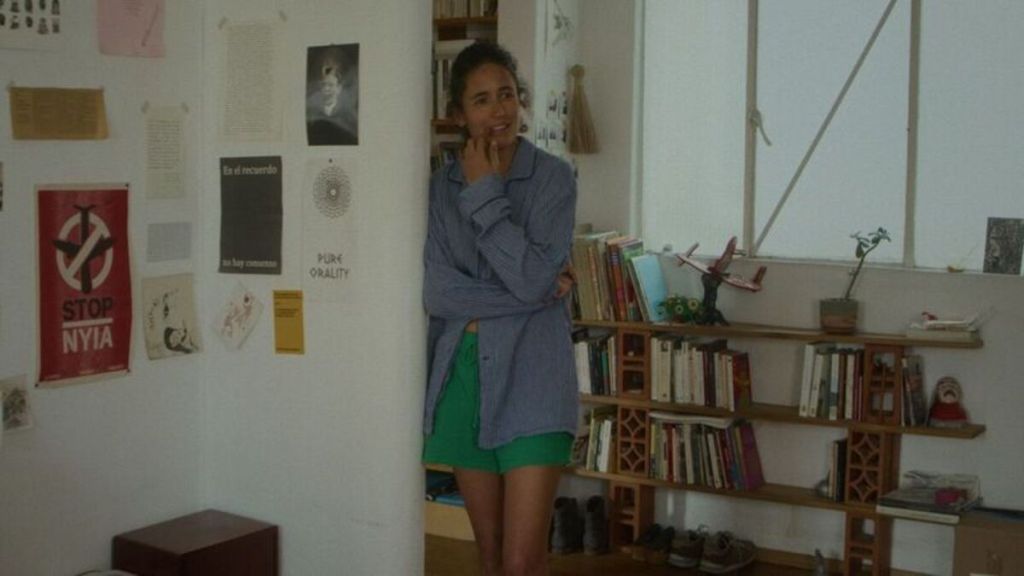
A film of variations, Pin de Fartie projects, stretches, and morphs the acts of viewing and storytelling inherent in Samuel Beckett’s Endgame (Fin de Partie) to form a vital dialog about filmmaking itself. In the sections closest to Beckett’s play, a girl (portrayed by director Alejo Moguillansky’s daughter and regular collaborator Cleo Moguillansky) serves as a weary caretaker to a demanding blind man (Santiago Gobernori). We also watch two silent and unnamed filmmakers creating sounds and models for the film we’re actively viewing, two actors rehearsing Endgame and falling in and out of their characters and their emerging romance, a mother and son reading Endgame and aligning their reality with the fiction, and a couple living in a large garbage bin somewhere in Buenos Aires. Interspliced between these various storylines, a woman (Luciana Acuña, Moguillansky’s wife and creative partner) provides connective narration alongside a musician (Maxi Prietto) who sings the sentiments and themes of each scenario. And, to top it all off, we view glimpses of the director’s hand underlining key passages in a printed copy of EndgamePin de Fartie brings together literature, music, and cinema, allowing the three to share the stage of the frame and communicate with each other. From their intertwining, Moguillansky reveals the magic of film as the conduit that can incorporate each artform’s strengths to bring us to new truths. A work ever moving toward farewells, Pin de Fartie has a mournful tone for what has been and what will be lost in each of its stories and in our overall zeitgeist, but rejoices in the endurance and infinite possibilities of the moving image and encourages us to place our hope there. A work that reaffirms El Pampero Cine’s standing as one of the most significant filmmaking collectives in the world, Pin de Fartie is a culmination of Moguillansky’s innovative, spirited, and collaborative methods of cinema and perfectly represents the ethos of the collective he co-founded. We had the privilege of speaking with director Alejo Moguillansky at AFI Fest 2025, and that conversation is available at Ink 19.

• •

Tóc, giấy và nước… (Hair, Paper, Water…) / Belgium, France, Vietnam / dirs Nicolas Graux and Trương Minh Quý

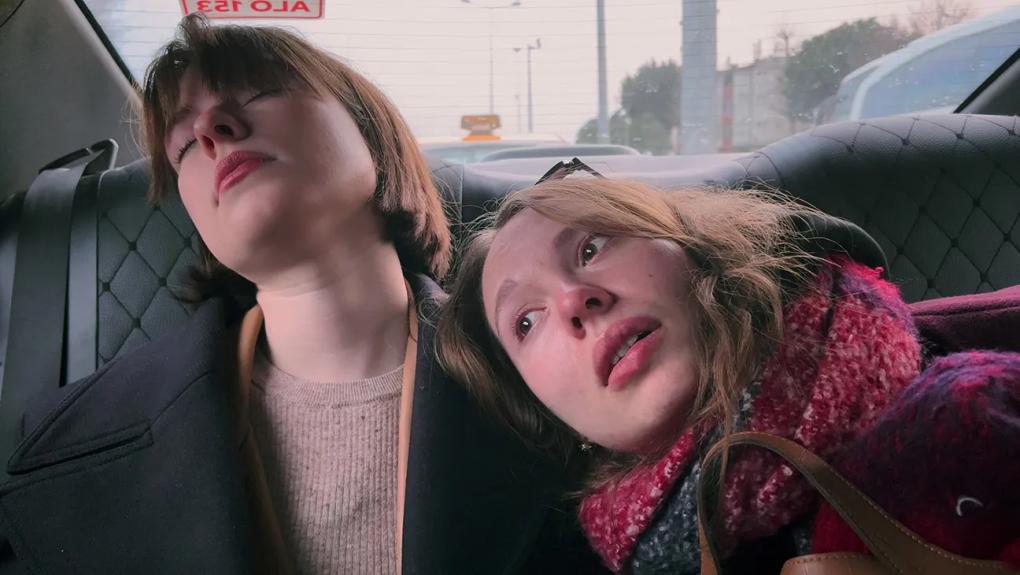
These days, the humanness of language is at the forefront of our minds. Multiple films on our list this year center on wordsmiths, but only Nicolas Graux and Trương Minh Quý’s Hair, Paper, Water…, the winner of the Pardo d’Oro in the Cineasti del Presente section at this year’s Locarno Film Festival, directly addresses how language historically sat at the foundation of our shared humanity and our umwelt and how its standing is changing. Part elegy, part homage, part memoir, the film sets forth Cao Thị Hậu, one of the primary subjects of Trương’s outstanding 2019 documentary, The Tree House, as our guide through the essence of language, and her grandson leads us through its preservation and transformation. Mrs. Cao speaks about her life and recounts memories and tales primarily in the critically endangered Rục language, and the directors pair her reflections and stories with sumptuous images, all captured with only two Bolex cameras, of her daily life and surroundings in a lush, nearly primordial valley not too far from the caves where she was born. Mrs. Cao forages medicinal plants, harvests cassava, sweeps out flood waters from her home, travels by canoe to her birthplace, and cares for grandson, whom she teaches the Rục language word-by-word. As she speaks the fundamental words around human cognition such as remember, fear, and think, as well as the essential terms for our habitats such as light, rain, fire, earth, and sky, and her grandson repeats each one in Rục, we see the Vietnamese equivalent in red text paired with striking glimpses of the natural setting. We also observe the grandson learning how to read and write Vietnamese through his homework; we watch and listen to him and his classmates learn how to read and speak English at school; and, we hear him tell the story about his father’s abandonment and his hopes for his own future in Vietnamese. The film is not only a rich anthropological study on generational change for the Rục ethnic minority, but also a poetic, delicate essay on how we universally learn how to perceive and describe the elements and phenomena in our world through family, education, and experience. Though the film never explicitly calls out the threat to language by contemporary technology, its visual and linguistic portrait of Mrs. Cao and her grandson capture a fleeting personal and cultural history, making Hair, Paper, Water… a touching archive of a key point in time and a contemplative farewell. And personally, for us, Hair, Paper, Water… takes on special significance because it recalls our memories of our first languages (Italian for Generoso and Vietnamese and Cantonese for Lily), our sorrow when struggle to remember the vocabulary, and our rejoicing when we can speak the words that first helped us understand our existence.

• •

Grand Tour / Portugal, Italy, France, Germany / dir Miguel Gomes

Having long admired Miguel Gomes’s work (his 2016 feature Arabian Nights topped our Best of Film list for the 2010s), we were beyond frustrated when his most recent film, Grand Tour, slipped through our fingers time and time again at multiple festivals in 2024. This fact is, of course, painfully ironic for us, as the central conceit of Grand Tour is the cat-and-mouse game through the Asian continent commenced by the nebbishy, but discombobulated Englishman Edward (Gonçalo Waddington), who makes the sudden and unexplained decision at a railway station in Rangoon to opt out of reuniting with his fiancé, Molly (Crista Alfaiate), whom he has not laid eyes on for the past seven years. Initially drawing inspiration from W. Somerset Maugham’s The Gentleman in the Parlour, a travelogue of Maugham’s 1923 trip through Burma and Siam, ending in Haiphong, Vietnam, Gomes, with his co-writers, Maureen Fazendeiro, Telmo Churro, and Mariana Ricardo, set the narrative of Grand Tour in 1918 but intersperse it with footage captured from Asia in the 2020s. The film takes on Edward’s perspective of his scattershot, play it by ear marital escape through multiple Asian countries during the first half before switching to Molly’s purposeful viewpoint in the latter half as she commits to “dragging Edward by the throat” if she finds him. Separate from one another and driven by different agendas, the individual journeys of Edward and Molly forgo any romantic tension, allowing the viewer to tag along. And in bringing together the disregard for period accuracy as Gomes did with the music and other cultural identifiers in his 2012 feature, Tabu, and the playfulness in the experimental comedic anarchy of the director’s 2021 comedy, The Tsugua DiariesGrand Tour develops into a pure experiential voyage that starts with specific travel destinations and opens up to the wonders of cinema, that magical realm where the laws of time and space don’t apply and where fiction can signify the real and vice versa. Created during pandemic restrictions, Gomes employed two cinematographers to film the Asian locales, Guo Liang and Apichatpong Weerasethakul’s regular DP, Sayombhu Mukdeeprom, and then staged the rest of the film with set pieces shot by the third DP, Rui Poças, in studios in Portugal, and this balance of the real and clearly artificial forms an enigmatic, timeless atmosphere fertile for a wide dearth of emotional reactions and interpretations along with a reawakened receptivity to the world around us and the worlds of the screen. A magnificent culmination of Gomes’s career so far, Grand Tour, for some, might seem like an unrequited love story between two people looking for entirely different outcomes, but for us, it is an ode to the power of observation and imagination and the places you can go when they intermingle.

• •

Geu jayeoni nege mworago hani (What Does That Nature Say To You) / South Korea / dir Hong Sangsoo

When we think of Hong Sangsoo’s films, we first recall his consistent tools for filmmaking: his regular players, particularly Kim Minhee and Kwon Haehyo, alcohol (often in soju or makgeolli form), cigarettes, and an artist protagonist. In reflecting on some of our favorite films of Hong, we recognize another common device — a painfully uncomfortable, embarrassing, and awkward confrontation. In 2024’s A Traveler’s Needs, the cringing point arrives when the mother of poet In-guk histrionically questions the young man’s reasons for allowing a French stranger (Isabelle Huppert) to live with him. In 2015’s Right Now, Wrong Then, it appears when the painter (Kim Minhee) awakens the director (Jung Jaeyoung) from his drunken sleep and proceeds to berate him after she learns about his reputation of disingenuousness. And in Hong’s latest, What Does That Nature Say To You, a genteel drinking challenge generates one of the most tortuous outbursts we’ve ever seen in a Hong Sangsoo film. What Does That Nature Say To You captures a single day for thirty-something poet Donghwa (Ha Seongguk). It all begins innocently enough: Donghwa drives his girlfriend Junhee (Kang Soyi) to her family home in Yeoju. He plans to drop her off and return immediately back to Seoul, but when he pulls up the driveway, Junhee’s father (Kwon Haehyo) is outside and insists that Donghwa stay for dinner. This naturally forces Donghwa to meet all of Junhee’s family for the first time, and they seize the opportunity to learn more about the boyfriend they’ve heard about for the past few years. Junhee’s sister (Park Miso) fixates on Donghwa’s esteemed attorney father and repeatedly prods to try to understand how much of his wealth has landed on Donghwa. Junhee’s father gives him a tour of the lush grounds of the family home originally built for Junhee’s grandmother, and in the process, quietly tests for Donghwa’s intentions with his daughter as well as his capacity to feel. Then, once she arrives home from work, Junhee’s mother (Cho Yunhee) makes a feast for everyone and proceeds to inquire about Donghwa’s poetry. Throughout the meal, Donghwa is gracious, complementary, respectful, and incredibly thoughtful in his comments around the mother’s poetry and the father’s landscaping talents. The parents meanwhile appear as good hosts, but in between smiles and then eventually drinks poured non-stop by Junhee’s father, they reveal their skepticism about Donghwa’s attempts to be independent, his philosophy for simple living, and his talent as a poet. After an intoxicated recitation of one of his poems and a modest criticism from Junhee’s sister, Donghwa melts down, precipitating a sequence of brutal revelations. With What Does That Nature Say To You, Hong utilizes the typical family drama trope of meeting a child’s romantic partner for the first time to provoke challenging questions about how familial structures and economic viability erode artistic inspiration and pure intentions. Donghwa may not be a good poet, but his spirit is exemplary, and watching it get challenged throughout What Does That Nature Say To You makes this one of Hong’s more tragic films to date.

• •

Sirât / France, Spain / dir Oliver Laxe

In the Sahara Desert, modernity has made few gains. Amongst the ancient sand, hills, and canyons, time as we know it is insignificant, and the environment is indifferent if not adversarial to our needs and desires as humans, making it a sobering grand stage for Oliver Laxe’s Sirât, a work that seeks to understand human and societal transitions and impermanence. Set in the Moroccan stretch of the Sahara during some unspecified point in the collapse of civilization, Sirât takes us on a grueling spiritual and physical journey as Luis (Sergi López) searches for his daughter Mar alongside his young son, Esteban (Bruno Núñez Arjona), and a pack of ravers (Stefania Gadda, Joshua Liam Herderson, Richard Bellamy ‘Bigui’, Tonin Janvier, and Jade Oukid, all non-professional actors and members of a rave collective). Disciplined in its structure and composition (narratively, visually, and sonically) while still reverent to the loose and uncontrollable nature of reality, Sirât forces us to repeatedly question how its title — named after As-Sirāt, the bridge over hell that must be crossed in order to attempt to reach paradise on the Day of Judgment in Islam, which Laxe explains plainly in text at the beginning of the film — manifests itself in the shared and divergent trajectories of each of its characters, who, out of the reach of most contemporary trappings, potentially enter interplanes separating Earth, purgatory, Hell, and Heaven. Though the desert landscape remains constant, Laxe, his cinematographer, Mauro Herce, and composer Kangding Ray astonishingly tie together image and sound to transmit ecstatic and terrifying glimpses into these spaces on and beyond Earth. We are at the denouement of life as we know it, and Sirât presses us to look at the path in front of us and to follow it as fearlessly as possible to where it ends.

• •

My Undesirable Friends: Part One—Last Air in Moscow / United States / dir Julia Loktev

What began in 2021 as a documentary about opposition journalists working at the last independent television station in Russia, TV Rain, which had been labeled as a “foreign agent” by Putin’s government, director Julia Loktev boldly expands into a harrowing and deeply personal film with multiple viewpoints on the repressive political maneuverings in the months leading up to the February 2022 invasion of Ukraine. Divided into five segments and clocking in at almost six hours, Loktev begins her feature by introducing us to Anya (Anna Nemzer), the senior host of two political programs at TV Rain and a mother raising an adolescent daughter in her family’s longtime apartment. These early scenes set what will turn out to be the comprehensive tone for Loktev’s film as she provides us unlimited access into Anya’s life, which includes everything from tension-filled workplace encounters to making dinner for her daughter and friends to the many direct-to-camera conversations with Loktev about the degrading state of Russia and the sometimes futile nature of her work that occur while the pair gets repeatedly stuck in Moscow traffic jams. Through Anya, we begin to meet the many journalists who will make up the rest of Loktev’s ensemble portrait: her co-worker Ksyusha (Ksenia Mironova), a young reporter at TV Rain whose fiancé has been jailed for treason, Olya (Olga Churakova) and Sonya (Sonya Groysman), who were amongst the first to be labeled as “foreign agents,” a fate which also befell Ira (Irina Dolinina) and Alesya (Alesya Marokhovskaya), who work at the investigative media outlet Important Stories, and celebrated veteran correspondent Lena (Elena Kostyuchenko), a dedicated writer for Novaya Gazeta who had been reporting on Russia’s actions against Ukraine since 2014. As she did with Anya, Loktev spends ample time with each of the aforementioned journalists as they valiantly attempt to inform the public about their firsthand observations on the authoritarian crackdowns that initially targeted only a small number of colleagues that will soon eliminate their entire professional community as Russia begins its full-scale war. Some 27 years ago, Loktev’s powerful debut documentary feature, Moment of Impact, meticulously explored the damaging effects of a car accident on her own parents’ lives, and in many ways, that same level of seldom-seen intimacy exists throughout My Undesirable Friends: Part One. After over three years of Russia’s horrific assault on the people of Ukraine, we might forget the circumstances that led to that action, but through Loktev’s film and her unprecedented look at the day-to-day lives of the people committed to telling the true story, we receive an alarmingly clear understanding of how each transgression against the press can lead to a total suppression of rights under a brutal dictatorship.

• •

Henry Fonda for President / Austria, Germany / dir Alexander Horwath

Director Alexander Horwath’s expansive experimental 185-minute essay, which is among the most impressive debut features we’ve seen in some time, explores the decades-long public façade of the everyman demonstrated in the films of the legendary star of Mister Roberts and how that image was created and reflected back onto the nation and even Fonda himself. Beginning with a scene from the Norman Lear sitcom Maude where the titular character devises a plan to run Fonda for the White House to heal the nation post-Watergate, Horwath’s film incorporates a staggering amount of clips from Fonda’s movie and television work that solidified his position as the ultimate do-gooder citizen, helping Americans to buy into the myth of homespun decency that became essential to the country’s self-perceived identity. Throughout the film, these scenes are astutely juxtaposed against a raw and never-before-released audiotaped interview with Fonda that occurred during his final year of life by Playboy magazine’s Lawrence Grobel that dispels the actor’s flawless persona with his own words. Horwath also presents further proof of the souring of the American ethos of right over might when he incorporates present-day recorded footage of the settings of Fonda’s films, such as the still-active migrant camps that Fonda’s Tom Joad experienced in The Grapes of Wrath and the town of Tombstone, Arizona, the setting for Fonda’s turn as famed lawman Wyatt Earp in My Darling Clementine, now reduced to a cheesy Western-reenactment attraction for tourists. As Horwath’s film progresses chronologically through Fonda’s life, we see an alignment of the actor’s selection of roles that furthered the public’s perception of him as the wise and friendly elder statesman that rings false now against the truths of his known rocky relationship with his children and the allegations made by his previous wives that labeled him as distant and cold. In the film’s final moments, Henry Fonda for President stresses the very real dangers of the constructed persona and how that feeds into our constant need to reinforce our own belief systems, even when we inherently know that the person whom we are rallying behind was most likely created to promote values that have been proven, time and time again, to be nothing more than a fantasy. Our full review of the film from earlier this year can be found at Ink 19.

• •

Reflet dans un diamant mort (Reflection In a Dead Diamond) / Belgium, Luxembourg, Italy, France / dirs Hélène Cattet and Bruno Forzani

It’s been eight years since Cattet and Forzani gave us their dazzling poliziotteschi-esque feature, Let the Corpses Tan, a scintillating adaptation of Jean-Patrick Manchette’s debut novel that transformed a relentless festival of gunfire under the Corsican sun into a wildly provocative performance art spectacle that was so enrapturing for us that it subsequently landed high on our Best of the 2010s film list. Drawing again from pulp literature and cult cinema’s past for their latest feature, Reflection In a Dead Diamond gathers its particular inspirations from the multinational productions of Euro-espionage thrillers from the 60s and 70s and the fumetti that inspired them for an adrenaline-fueled narrative that somehow outmatches the breakneck pace of their previous effort. For the film’s lead, Cattet and Forzani fittingly select the eternally elegant veteran of countless Euro-crime films, Fabio Testi, to portray John Diman, an elderly distinguished gentleman who spends his days relaxing oceanside by a palatial hotel on the Côte d’Azur that he calls home. It’s an idyllic final abode for John, but one that is suddenly disturbed by the appearance of his next-door neighbor, a stunning woman whose presence prompts a whirring recollection of his past exploits as a spy, or perhaps of his life as an actor who once portrayed a spy. Within these memories, which Cattet and Forzani present in a bedazzling and almost overwhelming manner, we meet John’s younger self (Yannick Renier), who dashingly fulfills his duties as a man of intrigue, complete with exceptionally tailored clothes, nifty techy tools, and a cadre of storybook foes, including the ninja-like leather-ensconced Serpentik (Thi Mai Nguyen), flashed quickly and without much explanation to eschew the outdated idea of a singular enemy. Although all of this may simply seem like a fetishistic cinematic homage, this feverish blending of various genre inspirations creates its own filmic language that fosters a compelling state of doubt for the viewer between the real and the unreal that entertainingly relinquishes any inclination you may have to attach yourself to a character or traditional genre outcome that would weigh down the experience of plunging into John’s memories. For its entire 87-minute running time, Reflection In a Dead Diamond bombards us with visuals and sounds that toy with how we recall the past while miraculously forging a storytelling technique that confronts our perspective on cinema.

• •

SUPPLEMENTAL FILMS

L’Accident de piano (The Piano Accident) / France / dir Quentin Dupieux

Perhaps the finest chameleon-esque actress working today, Adèle Exarchopoulos has fearlessly taken on an eclectic array of characters over her nearly twenty-year career. Though she’s mostly known for her dramatic projects, prior to The Piano Accident, Adèle had twice lent her considerable talents for small roles in Dupieux’s absurdist comedies, most notably in 2020’s Mandibles, where she drew peculiar inspiration from Greta Thunberg and uproariously punctuated scene after scene with her high-decibel line readings as an aggressively audibly impaired houseguest. For Dupieux’s newest feature, Adèle finally takes the lead as Magalie Moreau, an adult braces-wearing, poorly coiffed, and consistently marred social media sensation who has amassed considerable wealth from the time she was a tween by creating Tik Tok-length videos of her injuring herself through, at first, simple and then extravagant methods ranging from a drive-by baseball bat assault to getting run over by a wheel of a monster truck. Born without a shred of any real talent, but possessing an affliction that prevents her from feeling any pain, Magalie began her dubious career of self-abuse after seeing her unsupportive father roar in laughter while watching an episode of Jackass. As foul as all of this is, it’s seemingly business as usual for the callous Magalie and her obedient, but beleaguered manservant Patrick (Jérôme Commandeur) as they descend on an opulent secluded chalet for a bit of rest. However, once they arrive, there is trouble afoot in the form of Simone (Sandrine Kiberlain), a blackmailing journalist who knows a dark secret about one of Magalie and Patrick’s recent stunts gone wrong that could land them both in the clink. In response, the pair offer the journalist a tidy sum for her silence, but Simone demands the one thing that Magalie despises, a revealing interview for her publication that might open Magalie up and uncover the psyche that led her to this point in her life. One of the darkest and most affecting comedies Dupieux has made in his career, The Piano Accident finds the director continuing a theme that has been omnipresent in his work going back to Deerskin and through Smoking Causes Coughing and up to The Second Act: in our hyper connected world, the line between the truth and fiction for images captured from reality has blurred more than ever, leaving us unable to see who humans actually are and eroding our senses of self. As with most of Dupieux’s work, there is a lot packed into the short running time of The Piano Accident, but by smartly focusing almost exclusively on Adèle’s borderline sociopathic yet complex depiction of Magalie, it’s successful in gaining empathy for an unlikable figure, who, like so many in today’s world, is desperately manipulating technology to fit their own definition of a tangible existence.

• •

Kontinental ‘25 / Romania / dir Radu Jude

In the final scene of Rossellini’s neo-realist film, Europa ‘51, the namesake and quasi-inspiration for Radu Jude’s latest feature, a grief-stricken bourgeois wife of an American businessman, Irene Girard (Ingrid Bergman), now committed to a mental hospital, waves at the grateful destitute people she’s tried to help throughout her journey, and they proclaim her as a modern saint. Overwhelmed and rendered near catatonic by the unexpected suicide of her young son in the film’s first quarter, Irene’s journey in Europa ‘51 begins as a serendipitous clandestine mission outside of any faith or political agenda to help everyone she encounters as a method to compensate for a life of tone-deafness toward all outside of her elite circle. For Irene, a walk through any post-war Roman neighborhood beyond her own provides an instant opportunity for a philanthropic effort, but can she really make any difference given the scale of misery around her at that time? The same question can be asked of Kontinental ‘25’s Orsolya (in an outstanding performance from Eszter Tompa), an ethnic Hungarian court bailiff in the city of Cluj, Romania, who, like Irene, is gobsmacked from the guilt of a suicide she feels responsible for — that of a homeless man who crudely hangs himself when she gives him a moment to collect his belongings while she is carrying out her court-appointed duty of evicting him from a squat. Like Rossellini’s Irene, Orsolya at first takes refuge in her bed, but as the story of the suicide becomes more public through partisan news reports, she must also confront the onslaught of online comments from people who not only show their hatred for her actions, but also seem to relish the opportunity to slam her Hungarian background, stressing that particular divide in the country. Now inconsolable, Orsolya decides to let her family vacation without her in Greece as she roams the streets of her city, telling everyone she can find, from her mother to a priest to a former student turned bike delivery person, about her sadness. She is rudderless, and as we would expect from a Jude film, her journey is a dark and absurdly comedic one that has Orsolya taking an almost opposite path of that of Irene’s that is more endemic of our time of constant meaningless input. Lost in her misery, she helps no one in her travels, opting instead to clumsily descend toward a debaucherous rock bottom to gain some sense of clarity. In many ways, but most importantly with its use of a flawed but empathic protagonist, Kontinental ‘25 is the logical next feature for Jude, whose immensely profound and utterly enjoyable gut punch from 2023, Do Not Expect Too Much From the End of the World, also utilized a film from the past in its structure as a contrasting force to aggressively jab at the pitfalls of the Romanian version of late-stage capitalism that sees profits over the best interests of its citizens, who, like Orsolya, are uncertain of the necessary philosophy to adopt to overcome.

• •

Measures for a Funeral / Canada / dir Sofia Bohdanowicz

We first met the character of Audrey Benac (played by the brilliant Deragh Campbell) in 2019 when we viewed Sofia Bohdanowicz’s idiosyncratic and impressively reflective portrayal of archive excavation, MS Slavic 7. Since then, we’ve gone back into Bohdanowicz’s filmography to see earlier stages of Audrey in 2016’s Never Eat Alone and 2018’s Veslemøy’s Song and followed her progression in 2020’s Point and Line to Plane and 2021’s A Woman Escapes. Throughout the Audrey Benac films, the main character operates as a roman à clef lead, standing in for the director Bohdanowicz herself and navigating the history and present of the director’s own family’s artistic legacies to progress a discourse around the threads between self and kin. Suitably, Measures for a Funeral brings that discussion to its peak and close. The 2025 representation of Audrey is struggling on multiple fronts. Her dying mother throws a suffocating amount of guilt on her as she reveals her regret in sacrificing her career as a professional violinist to become a mother and requests that her daughter destroy her father’s violin, one of the only relics of his that remains. Her PhD thesis languishes as she falls deeper into the archives of her subject, the famed Canadian violinist Kathleen Parlow, who was also the mentor and teacher of her own grandfather. And she’s lost in her romantic life after deciding to end her long-term relationship with her partner without any clear reason. To try to recharge at least her academic pursuit, Audrey travels to England to visit one of her closest friends and to seek inspiration in Meldreth, a town that Parlow lived in for many years. On the trip, she, for the first time, speaks with full candor and vulnerability about why and how she feels so lost, and in this moment of openness, her friend provides new kindling to help Audrey’s self-illumination by suggesting that she restage the lost violin concerto by Johan Halvorsen, Opus 28, which was written for Parlow. Energized by this task, Audrey goes to Norway to bask in the space where Parlow performed the concerto for the first and only time and to seek the collaborators to make the restaging possible. Of course, Audrey’s personal reality bleeds in, since her father’s violin remains strapped to her back throughout her journey, and she must finally delineate her identity from the webs of her family and set the course for her own life. Measures for a Funeral feels like Bohdanowicz’s last film for Audrey Benac, but it releases her to a world of newfound possibilities, and we’re excited for both the director and her signature character. Our full review from August is available at Ink 19.

• •

I Dannati (The Damned) / Italy, United States, Belgium, France, Canada / dir Roberto Minervini

For the last two decades, director Roberto Minervini has created an impressive list of hybrid documentaries that examine the American identity with an incisiveness that few have been able to accomplish. A native-born Italian, Minervini has long lived in the Southern United States and has employed his objective position as an immigrant to examine a multitude of social and historical factors that led to the stagnant evolution of our indigent communities with his films such as 2015’s The Other Side and 2018’s What You Gonna Do When the World’s on Fire? Given his interest in our historical development, it only makes sense that for his first fiction feature, Minervini decided to go back to 1862 and the early days of the Civil War. The Damned follows a group of woefully unprepared Union soldiers sent to the Northwest part of the United States for reasons that the director purposefully obfuscates. Encamped in a wintry outpost, the men spend their days drinking, shooting at wild game, and chatting in an anachronistic vernacular that mashes up words from the present and the past to discuss various topics, including how their moral structure and faith played into their position on the abolition of slavery. The days are long for the men, and without any stated strategy to guide them, they wait for anything to happen. When an attack eventually commences without provocation, an erratic and terrifying blur of bodies and bullets surround our soldiers, leaving them to fire haphazardly at foes that they cannot see. They watch as their comrades’ bodies quickly fall to the ground, and after a few extremely harrowing minutes, the battle is over. It’s a grim scene, and all that the men can do is bury their dead and move on with their undefined mission, but as the days pass, their conversations turn to their depleting supplies and more random attacks, while their overall resolve weakens. By using an experimental technique that divorces the narrative from any historical details and cultural identifiers, Minervini, with The Damned, gives us an impactful way of looking at disenfranchised Americans who find themselves in a harrowing predicament that we are in no position to judge. The soldiers in The Damned are like any group of indigent people trapped by their situations in present-day America seen in the director’s previous films, people who are fighting for their lives due to unknown circumstances that put them in volatile places, leaving them without any real options to find peace and with no choice but to search for an undefinable enemy. Our full review of the film from earlier this year can be read at Ink 19.

• •

Fiume o morte! (Rijeka or death!) / Croatia, Italy, Slovenia / dir Igor Bezinović

This year marks the 106th anniversary of the unparalleled absurdity that was the siege and occupation of the Adriatic port of Fiume led by the eminent Italian poet, playwright, aristocrat, and army general Gabriele D’Annunzio. Angered that the city, which once had a substantial population of ethnic Italians, would be annexed by the then newly established Kingdom of Serbs, Croats, and Slovenes, D’Annunzio led a force of 186 “legionaries” from Ronchi in Italy to Fiume with the initial goal of reclaiming the former Roman province of Dalmatia for the new state of Italy. Once established in Fiume, these troops received reinforcements totalling over 2,500 men who were composed of Italian veterans of the Battles of the Isonzo and nationalists who subsequently forced the withdrawal of the Allied occupying forces there, leading to the establishment of the self-proclaimed state of the Reggenza Italiana del Carnaro, an event so audacious that it inspired the political leanings of a young Benito Mussolini. Now, as historically significant as all of this sounds on paper, a casual questioning of the current residents of Rijeka, Croatia (the former Fiume) garners only spotty recollections of this event, if any at all. Thus, in a salute to what Spanish-American philosopher George Santayana once wrote, “Those who cannot remember the past are condemned to repeat it,” hometown director Igor Bezinović leads the people of Rijeka into recreating D’Annunzio’s invasion for his oddly entertaining, but thought-provoking hybrid documentary, Fiume o morte! Fittingly, as a method to reconstruct the event for this current era of media oversaturation to forever bind this part of the town’s history in the minds of locals, Bezinović recruited anyone willing to don the military regalia of the invading forces to play a part and opted as well to find an endless throng of bald-headed men to play the Duce himself. With our players in place, and with the ethos similar to that of D’Annunzio, who hired professional photographers and cinematographers back in 1919 to film his actions to appear more like an artistic rendezvous rather than a hard-fought military campaign, the proceeding filming by Bezinović and cinematographer Gregor Bozic matches note for note the grand splendor of the images that were once sent back to the Italian homeland, where D’Annunzio, already revered as a celebrated artist and war hero, would be lauded as a conquering ruler. These contemporary scenes filmed by Bezinović are matched with archival footage and photographs throughout Fiume o morte!, which at first feel whimsical as the locals jest while being costumed, but as the combined images segue to December of 1920, when the city’s bridges were destroyed and soldiers laid dead after the town was stormed by the Royal Italian Army, these merged scenes dramatically change the tone of the film to accentuate the fatuity of that dark moment in Rijeka’s past. That shift in tone hammers home the ultimate message inherent in Fiume o morte!: although few in Rijeka remember D’Annunzio’s occupation, elaborately staged and documented audacious acts perpetrated by a cult of personality have an eternally seductive power that survives in many figures of today.

• •

Friendship / United States / dir Andrew DeYoung

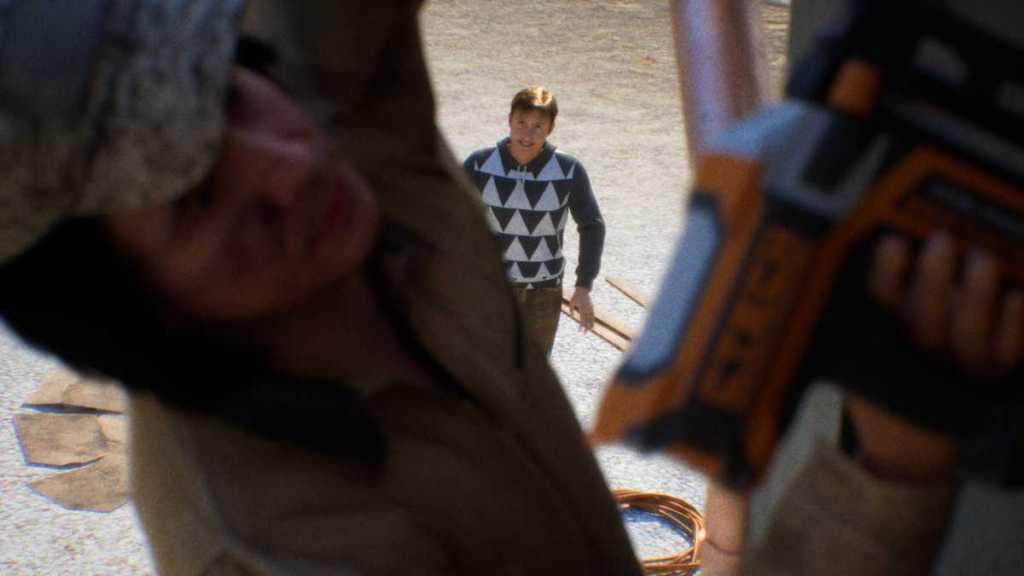
Much has been created in the last twenty-plus years in cinema to illustrate the negative impact that internet technology, and especially its ugly stepchild of social media, has had on contemporary society, but what of the plight of the denizens of lonely cubicles and shared desks around the world who toil incessantly to maximize brand clicks, push forward company agendas, and make apps more addictive despite the questionable nature of these duties? The latter lot in life is sadly that of Craig Waterman (Tim Robinson), a moderately successful marketing lead and unknowing poster child for autism who is shunned by his equally socially awkward workmates as well as his family, who all dismiss Craig’s feeble attempts at being a well-rounded man. It’s a sad sight to see, but from afar, Craig might seem a step or two up on the evolutionary vocation chain from his cinematic counterpart from six decades earlier, C.C. Baxter, Jack Lemmon’s shell of a man masquerading as an insurance clerk in Billy Wilder’s The Apartment, but the dire loneliness and unbeknownst lack of humanity are just as profoundly felt on this side of the screen. Craig is clearly frustrated by the lack of connection, but trudges on, and so, when he is tasked by his wife to bring a misdelivered package from their home to that of a nearby neighbor who just moved into their subdivision, he does so willingly. During this neighborly interaction, he meets Austin Carmichael (Paul Rudd), a local weatherman and alpha male, who soon invites Craig over for a drink and shows off the prehistoric weapon within the package that had been errantly dropped on his doorstep. They chat for a bit, and Austin takes a liking to Craig and proceeds to drag his new friend on adventures around town and into the woods akin to Water Rat and Mole from Wind in the Willows. Finally, Craig has excitement for something in his life outside of the home, but when a guys’ night at Austin’s house turns sour due to a misstep and then an overreaction from Craig, he is shunned by Austin. Alone again and visibly jarred by the rejection, Craig turns toward his family with new ideas for connection learned from his brief time with Austin, but he’s now even more psychologically ill-equipped to share his experiences with them, causing him to spiral out further. Not sure why pull quotes on Friendship labeled it as “laugh out loud funny.” This is a dark comedy of the 99% cacao variety of dark, and although a few scenes grant us an embarrassingly awkward laugh or two thanks to Tim Robinson’s uncanny talent of being affable while exuding sadness, Friendship operates as social tragedy. As Craig’s blunders pile up, director Andrew DeYoung molds a chilling portrait of the dysfunctional post-Covid male, who, to survive, has filled his life with rules and numbers that extinguish any natural instincts to evolve socially and render him unable to navigate our contemporary malaise.

• •

Un Poeta (A Poet) / Colombia, Germany, Sweden / dir Simón Mesa Soto

What a coincidence that the poet’s struggle lies at the heart of two of our favorite films from this year’s AFI Fest. And yet, it’s not a surprise in a time when expressive language, written for the mysterious and often indescribable moments and feelings of human existence, is declining, replaced by words generated from a massive corpora of all things online or, more frightfully, by a reductive language that seeks optimal superficial reaction with the fewest words and concepts. In Simón Mesa Soto’s A Poet, Oscar Restrepo (Ubeimar Rios) has been battling for an extended period against the forces that led to our current state of language and unfortunately has continued to fail. Once a young and award-winning poet and notable professor, Oscar now spends his days and nights as a drunkard who lives at home with his elderly mother. He consistently avoids working on his next book and takes any opportunity he can to espouse the virtues of poetry and lionize his hero, the tragic poet José Asunción Silva. A constant disappointment and embarrassment to his family and colleagues, Oscar learns about his daughter’s upcoming college plans and consequent financial needs and wants to contribute, even though he’s unequipped to do much. So with the help of his sister, he begrudgingly takes a job as a high school teacher. During one of Oscar’s inebriated lectures attempting to explain poetry to his uninterested pupils, the students point out Yurlady (Rebeca Andrade) as the sole young poet in the class, and he’s moved by the natural talent and earnestness in her writings and drawings. Oscar attempts to mentor Yurlady and convinces his poet colleagues to accept her into their poetry school. And for the first time in many years, the community of poets who have long seen Oscar as a wayward stepchild are delighted by one of his actions. But quickly their motivations misalign with Oscar’s: instead of encouraging Yurlady to build on her voice, they immediately laser in on the political value of Yurlady, who comes from a very poor family, and put in place the machinations to create a star sociopolitical poet perfect for the appetite of European donors and sponsors. Though a satire of the commoditization and debasement of art as well as the suffering for art, A Poet maintains an impressive humanity carried by the man portraying Oscar, Ubeimar Rios, a non-professional actor who is actually a high school philosophy teacher in real life. Rios soaks the delusional high poet Oscar with electric feeling and lures us into Oscar’s self-aggrandizement, self-loathing, and self-pity without alienating the viewer. Undoubtedly, Oscar is frustrating, but Rios’s performance along with Simón Mesa Soto’s direction and script instill a peculiar kind of nobility and innocence in a character who, despite all of the disappointing elements of life, art, and society, continues to seek the beauty of unadulterated poetry rooted in the sanctity of words, unfeigned emotion, and sober self-examination.

• •

BEST REPERTORY/RESTORATION SCREENING

Slade in Flame / United Kingdom / dir Richard Loncraine

First and foremost, we adore all manifestations of the glam into hard rock band Slade, but with the utmost respect to film critic Mark Kermode, who once described Loncraine’s bold and darkly comic feature Slade in Flame as “The Citizen Kane of British Pop Films,” we strongly feel that his appraisal is more fitting to John Boorman’s Catch Us If You Can, an utterly enjoyable and well-crafted pessimistic romp starring The Dave Clark Five from a decade earlier. That stated, we were as ecstatic as Kermode to see a new restoration of the glorious revelation that is Slade in Flame, which was completed and released just in time for the film’s fiftieth anniversary! Produced by Gavrik Losey, who is responsible for two of our all-time favorite music films, Joe Massot’s Two-Tone label concert extravaganza, Dance Craze, and Franco Rosso’s exquisite socially conscious reggae feature, BabylonSlade in Flame tells the origin story and subsequent demise of the fictional titular band Flame (Slade), the composite of two Midlands bands who selectively combine forces in prison following a clash during and after a shambolic gig. Once assembled, this newly formed band plays a raucous set at a nightclub, which simultaneously garners jeers and a dismissal from their low-level crime boss manager, Harding (Johnny Shannon), and positive interest from talent scout Tony Devlin (Kenneth Colley), who offers the band a visit to a London-based agency run by his upscale boss, Robert Seymour (Tom Conti). A businessman first and hardly a lover of music of any kind, Seymour is nevertheless genuinely interested in commoditizing Flame no differently than he would a brand of packaged fish sticks. Sans management, our group takes the offer of a new puppetmaster, and they’re off to lavishly staged photo shoots and carefully orchestrated bullet-soaked publicity stunts designed to push their new single, which soon flies off the shelves, leading the band to massive concert halls and eventually bitter infighting as the marketing and spectacle overtake the joys of creating and playing. Though they certainly include an endless buffet of comedic moments and exceptional live performances, Loncraine and screenwriter Andrew Birkin underlay their film in the world of the kitchen sink as they underscore the economic despair of the era, and like Catch Us If You CanSlade in Flame achieves a seamless construction that combines the bliss of being in a young rock band and the painful disappointment that comes with the added artificial, soul-crushing commercialization needed to sell the masses what the machine wants them to buy. Oh, and here, we 100% agree with Mark Kermode: Slade in Flame is the band’s best album.

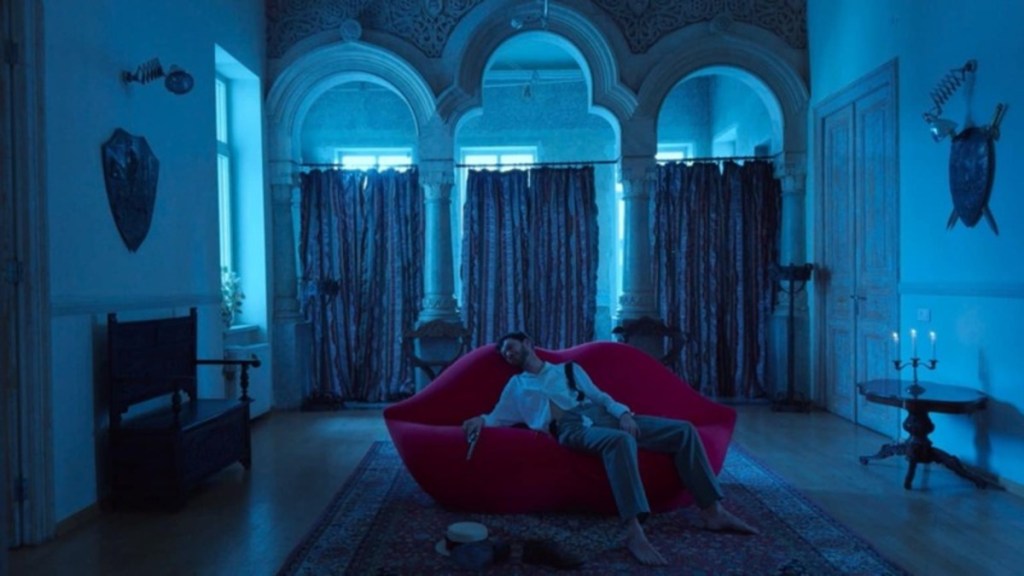
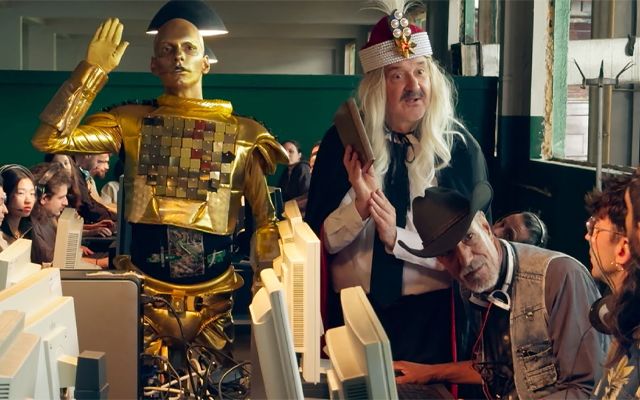
Featured photo from Radu Jude’s Dracula is courtesy of 1-2 Special.

Lily and Generoso

Lily and Generoso Fierro

Dracula

Standard

Originally published by Ink19 on November 5th, 2025

Dracula
directed by Radu Jude

In the first minutes of Radu Jude’s Dracula, a cacophony of AI-generated Vlad the Impalers appear, introduce themselves, and dare the audience to perform fellatio on him. Unlike the AI images and videos intended to mimic reality as much as possible, these creations appear as synthetic and synthesized as can be, somewhat like those mysterious cafeteria drinks of our childhood that we referred to by their color rather than any flavor. Immediately after, a bizarro director proxy for Jude (Adonis Tanța, the lay philosopher, law graduate, and bicycle delivery person in Jude’s earlier, less frenetic film of this year, Kontinental ‘25) introduces himself directly to the audience and explains that he’s been struggling to make a Dracula movie. He announces that he has decided to use AI to help him make something super commercial, and then we see the title card of Dracula, the name written in large cartoon blood letters standing above a quote from Wordsworth’s “Simon Lee: The Old Huntsman:”

O gentle Reader! you would find

A tale in every thing.

This sequence perfectly prepares us for the post-contemporary stylings of Jude, who gives us a pastiche of fifteen stories that take elements from literature, cinema, history, philosophy, TikTok videos, AI animations, and any form of culture or art imaginable. Just as the Wordsworth poem directs the tragic story of an aging hunter into a challenge on the reader to view Simon Lee not as a figure of entertainment, but rather as a symbol of the truths of reality, Jude utilizes Dracula and Vlad the Impaler and their corresponding mythologies alongside AI to force us to look at our role as consumers of the culture of reactivity and instantaneous gratification built by capitalism and the pursuit of technological progress in a post-Internet age.

Based on the paragraph above, you may think that Dracula is a solemn film. Some parts of it are. Many parts really are not! This is after all a Radu Jude film of the 2020s, which means you’ll see real and animated penises with a dash of dildos thrown in, gonzo sexuality, and, specifically in the case of Dracula, more fake blood than tender moments, but you’ll also see an incisive understanding of society, history, and cinema all packaged up in the director’s uniquely farcical yet penetrating ways.

In interviews and in the film itself, Jude describes Dracula as a film for everyone, and in a certain sense, this is true. Outside of the Jude stand-in voicing prompts for his choice of LLM, Dr. Judex 0.0 (voiced by our director Jude himself), to produce the stories on screen, the main connecting narrative fittingly involves something populist and tacky — dinner theater. In the first of many permutations of the Dracula story, Uncle Sandu (Gabriel Spahiu) and Vampira (Oana Maria Zaharia) stage condensed and eroticized sections of Bram Stoker’s version in a Gothic-lite dining room while also being auctioned off for sexual favors to the highest bidders. Some in the crowd refuse to take part in this salacious horror-themed flesh peddling, but of course, those people are cardboard cutouts. Throughout the performance, we hear people jeering and throwing out vulgar statements not unlike the comments on a livestream. And when the show invites the audience to participate in hunting Dracula and Vampira, the non-cardboard diners enthusiastically receive pointed wooden poles and run through the town like frenzied vampire hunters. A clear tourist trap, this dinner theater is the epitome of the commercialization of the Dracula myth in Romania, a phenomenon that only emerged after the fall of Nicolae Ceaușescu.

It turns out that during Communist rule, no one in Romania knew about Dracula and his various representations in the West because Ceaușescu intentionally prevented the films and books from getting translated and distributed there. After Ceaușescu’s televised execution and the nation’s movement towards capitalism, Romanians found out that most people outside of their borders knew only two figures from their country, Ceaușescu and Dracula. Initially, this was frustrating, but then people realized that they could profit from tourists seeking real-life places and relics mentioned in the Dracula and Vlad the Impaler myths, and alas, the figures became one of many tools for monetary gain, which given the damage that late-stage capitalism has wrought on Romania is an understandable option, even if it results in something as frightening and preposterous as the aforementioned song and dance, carnality-loaded dinner theater.

In this spirit, multiple stories in Jude’s Dracula show variants of the commercialization of the horror icons. In number four, “The Homecoming,” a shabby Vlad the Impaler played by Eszter Tompa (the bright star of Kontinental ‘25) causes a ruckus in the campy museum formed at the site of Vlad’s birthplace. In number seven, “Nosferatu/Murnau,” in response to a prompt to create a sequence inspired by the 1922 film, Dr. Judex 0.0 returns late night infomercials for medicines, Vlad the Impaler tours, and a penis enlargement clinic, all with visuals taken directly from Murnau’s Nosferatu. For story eleven, you have “Das Kapital,” where Dracula/Vlad appears as the exploitative boss of a black market video game operation who conjures up zombie stormtroopers to help him suck his striking workers dry, despite the pre-segment concerns from Jude’s stand-in about the cinematic cliche of using Dracula as a metaphor for the capitalist state who crushes the proletariat.

As this film was conceived to be a crowd-pleaser, we must take two pauses away from this morass of slams against all monetarily driven ideas of the Dracul. The first pause arrives early on as Jude’s proxy demands that the audience be given the love story that they have been promised, which prompts our AI to suggest an adaptation of Just So, an obscure and “profound” love story from Romanian author Nicolae Velea, with a mention of his nationality proving that Romanians can indeed create works that do not involve bloodsucking or impaling. “Just So,” story number five, has Dumenica, a rural truck driver, pursuing Adina, a comely agricultural technician. Adina is, at first, standoffish, but when the pair travels together along the stunning flower-strewn springtime countryside, their budding romance grows, but unfortunately, when he proclaims that he is married, reality creeps into their idyllic tryst, and Adina dies by, you guessed it, impaling herself accidentally on a roadside spike. Nice try, Dr. Judex 0.0. As the quote from Ludwig Wittgenstein, which is read before the final scene of Dracula, states, “The thing about progress is that it looks much bigger than it actually is.”

And for that final act, our directorial representative demands a dramatisation of a news story pulled from the headlines from Dr. Judex 0.0, resulting in a segment where a downtrodden and publicly-abused street cleaner is boxed out of attending a schoolyard performance by his tween daughter due to the embarrassing nature of his uniform. A story that feels sampled directly from a socially conscious Romanian New Wave film, here Vlad is viewed as a historic national hero, the subject of an invocation recited by an unseen child. This passage raises the most alarm of all, suggesting that AI, once it has nothing more to feast on from the tattered remains of Romanian myths, will descend on something less fantastical that might make the soul of the real, the artistic manifestation of the internal, feel unreal. Thanks for the Wordsworth quote, Radu. It helped.

If this almost three-hour experience from Jude seems too overwhelming, it should. Dracula is as bombastic of an experience as the equally polarizing 2019 masterwork from Albert Serra, Liberté. As excessive a piece as Jude’s Dracula, but one completely devoid of humor, Liberté also draws from the real and unreal of the past via the observation of a gaggle of elderly escaping Libertines whose wealth and servants facilitate their needs to play out any perverse fantasy that comes into their minds, all from the comfort of their regal carriages. This on-demand gratification, though centuries old, becomes a metaphor for our isolating technology-obsessed present where we can easily erode our abilities to imagine and communicate. Both Liberté and Dracula successfully comment on our eternal desire to manifest any whimsical notion, and both illuminate that getting exactly what you want whenever you want is probably something you should think about for a little while before you submit a request or click a button.

In homage to you, Radu, please permit us to pull a quote from William Blake by way of Bull Durham to bring this review to a close:

The road of excess leads to the palace of wisdom.

Dracula is in limited release now. It opens on November 8th at the Cleveland Cinematheque and on November 13th at the Somerville Theatre.

Featured photo courtesy of 1-2 Special.

Dracula

Lily and Generoso Fierro

AFI Fest 2025

Standard

Originally published on Ink19 on November 3rd, 2025

AFI Fest 2025
Los Angeles, California • October 22-26, 2025


For us, no fall is complete without reviewing the wildly eclectic offerings of the American Film Institute’s five-day festival that annually takes over the TCL Chinese Theatres on Hollywood Boulevard.

Every October, for five days and nights, AFI Fest presents some of the finest shorts and features drawn from the year’s prominent film festivals and pairs them with star-studded Hollywood premieres and first-time offerings. Over the last eleven years, we have frantically caught everything that we could during the fest and presented you with our capsule reviews of our favorite watches.

This year, we carefully selected 17 feature films to watch from the over 161 films in a stellar program comprised of 7 Red Carpet Premieres, 12 Special Screenings, 14 Luminaries selections, 15 Discovery films, 20 World Cinema selections, 15 Documentaries, 6 After Dark titles, 44 Short films, and 23 films from the AFI Conservatory Showcase! As has been the case in previous years at AFI Fest, the majority of our picks this year were drawn from the Luminaries, World Cinema, Documentary, and Discovery sections. Another strategy for us, especially given the larger than ever amount of programming offered, was to avoid films that already had scheduled nationwide releases for shortly after the festival, which allowed us to conserve our time for those that most likely wouldn’t make it to US theaters until 2026.

Mixed into the offerings were 19 Best International Feature Oscar® submissions, and we are thankful that we had the chance to see several of them, including Simón Mesa Soto’s accomplished second feature, Un Poeta (A Poet), from Colombia, Igor Bezinović’s innovative hybrid-documentary, Fiume o morte! (Rijeka or death!), and Jeunes mères (Young Mothers), another in a long line of social realist masterworks from the Dardenne Brothers representing Belgium, all three of which we have reviewed for you below along with five other films that we admire, beginning with our favorite from this year’s festival.

• •

Pin De Fartie

dir Alejo Moguillansky / Argentina

A film of variations, Pin de Fartie projects, stretches, and morphs the acts of viewing and storytelling inherent in Samuel Beckett’s Endgame (Fin de Partie) to form a vital dialog about filmmaking itself. In the sections closest to Beckett’s play, a girl (portrayed by director Alejo Moguillansky’s daughter and regular collaborator Cleo Moguillansky) serves as a weary caretaker to a demanding blind man (Santiago Gobernori). We also watch two silent and unnamed filmmakers creating sounds and models for the film we’re actively viewing, two actors rehearsing Endgame and falling in and out of their characters and their emerging romance, a mother and son reading Endgame and aligning their reality with the fiction, and a couple living in a large garbage bin somewhere in Buenos Aires. Interspliced between these various storylines, a woman (Luciana Acuña, Moguillansky’s wife and creative partner) provides connective narration alongside a musician (Maxi Prietto) who sings the sentiments and themes of each scenario. And, to top it all off, we view glimpses of the director’s hand underlining key passages in a printed copy of EndgamePin de Fartie brings together literature, music, and cinema, allowing the three to share the stage of the frame and communicate with each other. From their intertwining, Moguillansky reveals the magic of film as the conduit that can incorporate each artform’s strengths to bring us to new truths. A work ever moving towards farewells, Pin de Fartie has a mournful tone for what has been and what will be lost in each of its stories and in our overall zeitgeist, but rejoices in the endurance and infinite possibilities of the moving image and encourages us to place our hope there. A work that reaffirms El Pampero Cine’s standing as one of the most significant filmmaking collectives in the world, Pin de Fartie is a culmination of Moguillansky’s innovative, spirited, and collaborative methods of cinema and perfectly represents the ethos of the collective he co-founded. We had the privilege of speaking with director Alejo Moguillansky prior to the festival, and that conversation is available here.

• •

Geu jayeoni nege mworago hani (What Does That Nature Say To You)

dir Hong Sangsoo / South Korea

When we think of Hong Sangsoo’s films, we first recall his consistent tools for filmmaking: his regular players, particularly Kim Minhee and Kwon Haehyo, alcohol (often in soju or makgeolli form), cigarettes, and an artist protagonist. In reflecting on some of our favorite films of Hong, we recognize another common device — a painfully uncomfortable, embarrassing, and awkward confrontation. In 2024’s A Traveler’s Needs, the cringing point arrives when the mother of poet In-guk histrionically questions the young man’s reasons for allowing a French stranger (Isabelle Huppert) to live with him. In 2015’s Right Now, Wrong Then, it appears when the painter (Kim Minhee) awakens the director (Jung Jaeyoung) from his drunken sleep and proceeds to berate him after she learns about his reputation of disingenuousness. And in Hong’s latest, What Does That Nature Say To You, a genteel drinking challenge generates one of the most tortuous outbursts we’ve ever seen in a Hong Sangsoo film. What Does That Nature Say To You captures a single day for thirty-something poet Donghwa (Ha Seongguk). It all begins innocently enough: Donghwa drives his girlfriend Junhee (Kang Soyi) to her family home in Yeoju. He plans to drop her off and return immediately back to Seoul, but when he pulls up the driveway, Junhee’s father (Kwon Haehyo) is outside and insists that Donghwa stay for dinner. This naturally forces Donghwa to meet all of Junhee’s family for the first time, and they seize the opportunity to learn more about the boyfriend they’ve heard about for the past few years. Junhee’s sister (Park Miso) fixates on Donghwa’s esteemed attorney father and repeatedly prods to try to understand how much of his wealth has landed on Donghwa. Junhee’s father gives him a tour of the lush grounds of the family home originally built for Junhee’s grandmother, and in the process, quietly tests for Donghwa’s intentions with his daughter as well as his capacity to feel. Then, once she arrives home from work, Junhee’s mother (Cho Yunhee) makes a feast for everyone and proceeds to inquire about Donghwa’s poetry. Throughout the meal, Donghwa is gracious, complementary, respectful, and incredibly thoughtful in his comments around the mother’s poetry and the father’s landscaping talents. The parents meanwhile appear as good hosts, but in between smiles and then eventually drinks poured non-stop by Junhee’s father, they reveal their skepticism about Donghwa’s attempts to be independent, his philosophy for simple living, and his talent as a poet. After an intoxicated recitation of one of his poems and a modest criticism from Junhee’s sister, Donghwa melts down, precipitating a sequence of brutal revelations. With What Does That Nature Say To You, Hong utilizes the typical family drama trope of meeting a child’s romantic partner for the first time to provoke challenging questions about how familial structures and economic viability erode artistic inspiration and pure intentions. Donghwa may not be a good poet, but his spirit is exemplary, and watching it get challenged throughout What Does That Nature Say To You makes this one of Hong’s more tragic films to date.

• •

Kontinental ‘25

dir Radu Jude / Romania

In the final scene of Rossellini’s neo-realist film, Europa ‘51, the namesake and quasi-inspiration for Radu Jude’s latest feature, a grief-stricken bourgeois wife of an American businessman, Irene Girard (Ingrid Bergman), now committed to a mental hospital, waves at the grateful destitute people she’s tried to help throughout her journey, and they proclaim her as a modern saint. Overwhelmed and rendered near catatonic by the unexpected suicide of her young son in the film’s first quarter, Irene’s journey in Europa ‘51 begins as a serendipitous clandestine mission outside of any faith or political agenda to help everyone she encounters as a method to compensate for a life of tone-deafness towards all outside of her elite circle. For Irene, a walk through any post-war Roman neighborhood beyond her own provides an instant opportunity for a philanthropic effort, but can she really make any difference given the scale of misery around her at that time? The same question can be asked of Kontinental ‘25’s Orsolya (in an outstanding performance from Eszter Tompa), an ethnic Hungarian court bailiff in the city of Cluj, Romania, who, like Irene, is gobsmacked from the guilt of a suicide she feels responsible for — that of a homeless man who crudely hangs himself when she gives him a moment to collect his belongings while she is carrying out her court-appointed duty of evicting him from a squat. Like Rossellini’s Irene, Orsolya at first takes refuge in her bed, but as the story of the suicide becomes more public through partisan news reports, she must also confront the onslaught of online comments from people who not only show their hatred for her actions, but also seem to relish the opportunity to slam her Hungarian background, stressing that particular divide in the country. Now inconsolable, Orsolya decides to let her family vacation without her in Greece as she roams the streets of her city, telling everyone she can find, from her mother to a priest to a former student turned bike delivery person, about her sadness. She is rudderless, and as we would expect from a Jude film, her journey is a dark and absurdly comedic one that has Orsolya taking an almost opposite path of that of Irene’s that is more endemic of our time of constant meaningless input. Lost in her misery, she helps no one in her travels, opting instead to clumsily descend towards a debaucherous rock bottom to gain some sense of clarity. In many ways, but most importantly with its use of a flawed but empathic protagonist, Kontinental ‘25 is the logical next feature for Jude, whose immensely profound and utterly enjoyable gut punch from 2023, Do Not Expect Too Much From the End of the World, also utilized a film from the past in its structure as a contrasting force to aggressively jab at the pitfalls of the Romanian version of late-stage capitalism that sees profits over the best interests of its citizens, who, like Orsolya, are uncertain of the necessary philosophy to adopt to overcome.

• •

Fiume o morte! (Rijeka or death!)

dir Igor Bezinović / Croatia, Italy, Slovenia

This year marks the 106th anniversary of the unparalleled absurdity that was the siege and occupation of the Adriatic port of Fiume led by the eminent Italian poet, playwright, aristocrat, and army general Gabriele D’Annunzio. Angered that the city, which once had a substantial population of ethnic Italians, would be annexed by the then newly established Kingdom of Serbs, Croats, and Slovenes, D’Annunzio led a force of 186 “legionaries” from Ronchi in Italy to Fiume with the initial goal of reclaiming the former Roman province of Dalmatia for the new state of Italy. Once established in Fiume, these troops received reinforcements totalling over 2,500 men who were composed of Italian veterans of the Battles of the Isonzo and nationalists who subsequently forced the withdrawal of the Allied occupying forces there, leading to the establishment of the self-proclaimed state of the Reggenza Italiana del Carnaro, an event so audacious that it inspired the political leanings of a young Benito Mussolini. Now, as historically significant as all of this sounds on paper, a casual questioning of the current residents of Rijeka, Croatia (the former Fiume) garners only spotty recollections of this event, if any at all. Thus, in a salute to what Spanish-American philosopher George Santayana once wrote, “Those who cannot remember the past are condemned to repeat it,” hometown director Igor Bezinović leads the people of Rijeka into recreating D’Annunzio’s invasion for his oddly entertaining, but thought-provoking hybrid documentary, Fiume o morte! Fittingly, as a method to reconstruct the event for this current era of media oversaturation to forever bind this part of the town’s history in the minds of locals, Bezinović recruited anyone willing to don the military regalia of the invading forces to play a part and opted as well to find an endless throng of bald-headed men to play the Duce himself. With our players in place, and with the ethos similar to that of D’Annunzio, who hired professional photographers and cinematographers back in 1919 to film his actions to appear more like an artistic rendezvous rather than a hard-fought military campaign, the proceeding filming by Bezinović and cinematographer Gregor Bozic matches note for note the grand splendor of the images that were once sent back to the Italian homeland, where D’Annunzio, already revered as a celebrated artist and war hero, would be lauded as a conquering ruler. These contemporary scenes filmed by Bezinović are matched with archival footage and photographs throughout Fiume o morte!, which at first feel whimsical as the locals jest while being costumed, but as the combined images segue to December of 1920, when the city’s bridges were destroyed and soldiers laid dead after the town was stormed by the Royal Italian Army, these merged scenes dramatically change the tone of the film to accentuate the fatuity of that dark moment in Rijeka’s past. That shift in tone hammers home the ultimate message inherent in Fiume o morte!: although few in Rijeka remember D’Annunzio’s occupation, elaborately staged and documented audacious acts perpetrated by a cult of personality have an eternally seductive power that survives in many figures of today.

• •

Jeunes mères (Young Mothers)

dirs Jean-Pierre Dardenne and Luc Dardenne / Belgium, France

For many months before viewing Young Mothers, the newest feature from veteran social realist directors Jean-Pierre and Luc Dardenne, we’ve had their work at the forefront of our minds as Émilie Dequenne, the bright star of the brothers’ Palme D’Or-winning feature from 1999, Rosetta, passed away at the age of 43 in March of this year. Dequenne deservedly picked up a Best Actress award at Cannes for her devastating performance as the titular character, the only child of an incapable alcoholic mother who ferociously scrapes out a meager existence while living in a despot trailer park. Rosetta, like many of the protagonists of the Dardennes’ films, is thrust into a role that would hobble many adults twice her age while still only a child herself. A similar predicament can be said of the women at the center of Young Mothers: Jessica (Babette Verbeek), Perla (Lucie Laruelle), Julia (Elsa Houben), and Ariane (Janaïna Halloy), an in-need group of teens with dramatically different backgrounds who have recently given birth or are expecting to and who all reside in a publicly funded center in the Belgian city of Liège that offers them forms of assistance as they transition into parenthood or opt to offer their children up for adoption. Visually structured to feel like a hybrid documentary, our protagonists were actually portrayed by non-professional actresses who triumph when they convey their emotional makeups every time the focus shifts to their plights in this rare ensemble piece from the Dardennes, who have, over their long careers, normally opted to concentrate their stories on one or two central characters. In fact, given the subject matter of Young Mothers, it is near impossible not to think of the brothers’ film from twenty years ago, L’Enfant, which centers on a young couple who are ill-prepared to raise a child and consequently make criminal decisions to attempt to improve their situation. But unlike the desperate nature and pace of L’Enfant and RosettaYoung Mothers distinguishes itself in its ability to absorb the hard times experienced by its central characters through a complete picture of each of their struggles in conjunction with the support system of the group home that allows each of them to understand the options for their futures with some clarity. Although the outcome is far from a happy ending, this affecting and poignant feature presents a compelling positive shift in perspective for the Dardennes, who here illuminate a pathway for their characters that stems more from individual growth facilitated by community support and less from the survival instincts needed to overcome daily hardships that marked the predominance of their early work.

• •

Un Poeta (A Poet)

dir. Simón Mesa Soto / Colombia, Germany, Sweden

What a coincidence that the poet’s struggle lies at the heart of two of our favorite films from this year’s AFI Fest. And yet, it’s not a surprise in a time when expressive language, written for the mysterious and often indescribable moments and feelings of human existence, is declining, replaced by words generated from a massive corpora of all things online or, more frightfully, by a reductive language that seeks optimal superficial reaction with the fewest words and concepts. In Simón Mesa Soto’s A Poet, Oscar Restrepo (Ubeimar Rios) has been battling for an extended period against the forces that led to our current state of language and unfortunately has continued to fail. Once a young and award-winning poet and notable professor, Oscar now spends his days and nights as a drunkard who lives at home with his elderly mother. He consistently avoids working on his next book and takes any opportunity he can to espouse the virtues of poetry and lionize his hero, the tragic poet José Asunción Silva. A constant disappointment and embarrassment to his family and colleagues, Oscar learns about his daughter’s upcoming college plans and consequent financial needs and wants to contribute, even though he’s unequipped to do much. So with the help of his sister, he begrudgingly takes a job as a high school teacher. During one of Oscar’s inebriated lectures attempting to explain poetry to his uninterested pupils, the students point out Yurlady (Rebeca Andrade) as the sole young poet in the class, and he’s moved by the natural talent and earnestness in her writings and drawings. Oscar attempts to mentor Yurlady and convinces his poet colleagues to accept her into their poetry school. And for the first time in many years, the community of poets who have long seen Oscar as a wayward stepchild are delighted by one of his actions. But quickly their motivations misalign with Oscar’s: instead of encouraging Yurlady to build on her voice, they immediately laser in on the political value of Yurlady, who comes from a very poor family, and put in place the machinations to create a star sociopolitical poet perfect for the appetite of European donors and sponsors. Though a satire of the commoditization and debasement of art as well as the suffering for art, A Poet maintains an impressive humanity carried by the man portraying Oscar, Ubeimar Rios, a non-professional actor who is actually a high school philosophy teacher in real life. Rios soaks the delusional high poet Oscar with electric feeling and lures us into Oscar’s self-aggrandizement, self-loathing, and self-pity without alienating the viewer. Undoubtedly, Oscar is frustrating, but Rios’s performance along with Simón Mesa Soto’s direction and script instill a peculiar kind of nobility and innocence in a character who, despite all of the disappointing elements of life, art, and society, continues to seek the beauty of unadulterated poetry rooted in the sanctity of words, unfeigned emotion, and sober self-examination.

• •

Sehnsucht in Sangerhausen (Phantoms of July)

dir Julian Radlmaier / Germany

How and why certain film titles receive entirely new names when they cross the Atlantic completely perplexes us. One case we frequently cite is Wim Wenders’s Im Lauf der Zeit: the title’s direct translation is something along the lines of “as time goes by,” but in the US, the film became known as Kings of the Road. We felt similarly confounded when we learned that Julian Radlmaier’s Sehnsucht in Sangerhausen translates directly to “longing in Sangerhausen,” an apt title given its examination through four different stories set in the eastern German town of Sangerhausen, all unified by the working person’s desire for an unspecified better life, a commonality that triumphs over time, nationality, and personal experience. However, in arriving to American audiences, the title somehow became Phantoms of July, which captures the slightly fantastical tone of the film, but completely erases the importance of the setting and the force that motivates the film’s characters. Please forgive us for the extended complaint, and let’s put aside concerns about the name because Phantoms of July ruminates on the isolation and yearning of workers with an impressive acuity and refreshing gentleness that deserves attention in this year’s AFI Fest wrap up. The film opens in the late 1700s in the home of the German aristocrat and famed romantic poet, Novalis, the author of Heinrich von Ofterdingen, the story which introduced the blue flower as a symbol of longing for the Romantic movement. Instead of focusing on Novalis, Radlmaier points our attention to Novalis’s housemaid Lotte, who finds a strangely beautiful blue stone in a field one morning while fetching milk. Lotte later meets a vagabond performer who dreams of travelling to France, for he’s heard, “They cut off the necks of princes there. All people are now equal and live freely like birds.” Inspired by such a place, Lotte and the performer take a horse from Novalis and try to escape to the freer land, but don’t get there. Fast forward to the Sangerhausen of the 21st century where Ursula, Neda, and Sungnam strive to make a living. Ursula, a daughter of the town whose family has lived in the area for too many generations to count, works as an off-hours cleaner for a furniture depot and as a waitress for the cafe in the Sangerhausen’s famous rose gardens. Neda, an Iranian refugee, travels around the town with her arm in a sling from an unknown injury and records sterile and insincere commentary of the sights. A former filmmaker who studied with Iran’s greatest directors, she’s attempting to build a career as a travel influencer and struggling to make ends meet. And in the town square, Sungnam, donning a neck brace, offers tours in an aging powder blue van daily without any takers. The three don’t have any reason to interact with each other, but elements from their working lives coincidentally propel them towards each other and towards Sangerhausen’s history. Phantoms of July excels in understanding how class and status as immigrants create separations between people and how such divides can be breeding grounds for cruelty but also unity without overstating its purpose and intention. In fact, Phantoms of July has a light touch that reveals a mutual hope between its characters that enables them to have empathy for each other, an understanding that we desperately need now.

• •

The Ozu Diaries

dir Daniel Raim / USA

I (Generoso) owe an almost four-decades-overdue thanks to the clerk of a now defunct art video store off of South Street in Philadelphia who insisted that I couldn’t leave his shop without renting Yasujirō Ozu’s Tokyo Story. As a young cineaste who had only seen a few essential films by Kurosawa up to that point, including an unplanned screening of Ran during a rainstorm that I hold as a pivotal point in my development, I outwardly longed to view more Japanese cinema, which inspired the aforementioned rental challenge from the employee at the video store, who thankfully was always beyond eager to make an on-point recommendation. My subsequent viewing of Ozu’s film, despite the less-than-ideal quality of the VHS tape and my small television screen, affected me in a way that few films had, which led me to hunt for as many of Ozu’s other works that I could find on video at that time in the 1980s and to read whatever books and articles I could to help me understand why these films impacted me so profoundly. A trip to the downtown central library put Donald Petrie’s book, Ozu: His Life and Films, in my hands, and although I have read multiple pieces since, I am forever interested in delving deeper into Ozu’s biographical history and creative process. Fortunately, back in 2018 and 2019, director Daniel Raim, who clearly shares a similar passion for Ozu, created two short films that examined specific aspects of the creative underpinnings of the director: The Search for Ozu and Ozu and Noda. The former film delves into the inspirations and techniques that went into the visual composition of Ozu’s films, and the latter shorter piece takes a look at Ozu’s personal relationship and screenwriting partnership with Kogo Noda, which resulted in twenty-seven films over a thirty-five year period that ended with Ozu’s death in 1963. For his latest full-length documentary, The Ozu Diaries, Raim uses unprecedented access to Ozu’s personal journals to create a more intimate portrait of the director that spans from his earliest memories of his parents, through his experiences as a young filmmaker and a combat soldier, and into to his most private thoughts as a veteran director looking at his cinematic collaborators and close friends. Structurally, apart from an early scene in The Ozu Diaries where Ozu elucidates on his father’s death, Raim’s film follows a linear timeline and uses voiceovers that draw directly from Ozu’s writings, which are placed over an astonishing array of corresponding visuals of photos and segments from Ozu’s films that effectively draw you into Ozu’s mindset, creating a somber tone for the documentary, disrupted only by spliced in testimonies to Ozu from contemporary filmmakers, which do more to distract than add to the overall impact of the piece. Despite the inclusion of these talking heads, The Ozu Diaries successfully builds on Raim’s earlier shorts on Ozu while accomplishing its goal of offering insight into the filmmaker’s life to give any admirer of the director a deeper understanding of the possible motivations and inspirations behind the perspicacious and affecting choices that he made for the screen.

• •

All films were screened at AFI Fest 2025. We offer our thanks and congratulations to the staff and volunteers of AFI Fest for another excellent year of cinema and conversations, and we send a special thanks as always to Johanna Calderón-Dakin, Senior Publicity Associate for AFI Fest, who made our coverage possible.

Featured photo of Guest Artistic Director Guillermo del Toro at AFI FEST 2025 courtesy of AFI Fest.

Alejo Moguillansky

Standard

Originally published on Ink19 on October 21, 2025

Interview conducted by Lily and Generoso on October 10, 2025

A polyglot of artistic languages and a keen observer of the evolving conditions of our reality, Alejo Moguillansky has built his directorial oeuvre on mixtures of permutations drawn from literature, music, cinema, dance, and the process of filmmaking itself. One of the co-founders of El Pampero Cine, the collective of renegade independent filmmakers responsible for some of the most innovative films from Argentina for over two decades, Moguillansky, as an editor, has worked on the predominance of the output of El Pampero Cine, including Mariano Llinás’s magnum opus, La Flor, and Laura Citarella’s renowned extended mystery, Trenque Lauquen. And outside of the collective, he has edited the films of fellow directors such as Matías Piñeiro, Santiago Mitre, and Hugo Santiago. In turn, it is no surprise that Moguillansky’s own films move and flow with a rhythm and jazz-like discipline in creating structure from a multitude of riffs only possible from the eyes and timing of a consummate editor.

In his latest feature, Pin de Fartie, Moguillansky selects Samuel Beckett’s Endgame for the base melody and provides three variations of it while also layering in passages that celebrate filmmaking, storytelling, and music. In the first variation, which stands as the closest to the source material, Cleo (played by the director’s daughter and longtime ensemble member Cleo Moguillansky) and Otto (Santiago Gobernori) live, contemplate, and bicker in the closing days of their complicated father-daughter and master-servant relationship. In the second variation, two actors (Laura Paredes and Marcos Ferrante) rehearse Endgame and vacillate between the harshness of their characters and their growing love for each other. In the third variation, a son (played by the director himself) and his blind elderly mother (the renowned pianist and regular collaborator Margarita Fernández) stop their daily ritual around piano performance and replace it with daily recitations of Endgame, illuminating the similarities between the piece and the relationship between the parent approaching the end of life and the adult child. Connecting these variations, co-director and longtime collaborator Luciana Acuña and composer Maxi Prietto provide a chorus built on narration and acoustic rock. To top it all off, Moguillansky gives us delightful interludes of cinematographers Inés Duacastella and Ana Roy at work making movie magic happen: producing the sound of planes overhead with a moving blow torch, creating the reflection of the moon in a pool of water, and manufacturing the sound of waves on rocks within a plastic container.

Such a description may sound overwhelming, but the many parts bounce off each other and dance together with a wondrous coherence that is Moguillansky’s signature playful, irreverent, revelatory, and wide-eyed spirit. His films are knowing yet effervescent, never weighed down by cynicism, grounded in a deep understanding of the sorrows and difficulties of the times, invigorated by the profound joy and fascination that the director finds in all art forms, and lifted with an appreciation for the absurd. Pin de Fartie epitomizes the director’s methodology and declares his devotion to cinema, resulting in a work that assures us that film is alive and well even under the increasing chaos of today.

On the occasion of Pin de Fartie’s screening at AFI Fest 2025, we had the privilege of interviewing Alejo Moguillansky. We spoke about the impact of the pandemic on his viewpoint as a filmmaker, his approach to conceptual and visual motifs, and his dedication to finding truth and beauty through film and cinematic history.

• •

LF: Towards the end of La edad media (The Middle Ages), in a heartbreaking moment of revelation, your wife and creative partner, Luciana Acuña, states, “As if it didn’t make sense that we should be the ones who construct that new form of post-pandemic art, […] I reckon we have to quit.” How did that declaration of the need for change after the pandemic play out in the formation of Pin de Fartie? How did it motivate you to shift your focus away from the struggle of working as an artist, a recurring theme in your films that’s not explored in Pin de Fartie?

AM: I don’t know if there is an answer for that, but I remember that statement in The Middle Ages very well. It was a sensation that we all had during those days. The pandemic and this situation of us being all together and enclosed at home led to questions regarding future generations. Specifically, would this be the end of our generation? Who will need us after all of this? This is a clever question…Pin de Fartie has this long feeling of an ending, and yet something is trying to survive, and it is condemned not to die. That is the tricky thing about Pin de Fartie. There are two people saying goodbye and saying goodbye forever. So, now that I think about it, Pin de Fartie is totally related to that statement in The Middle Ages, but I wasn’t conscious of this before.

Of course, after the pandemic restrictions in Argentina, we had a Libertarian government made of very right wing vulgar people — people who were nearly trying to destroy culture and destroy cinema, but you, of course, are no luckier that we are with this situation in the United States, yes? So, this predicament of being a stranger in your own country is inherent in Pin de Fartie as well as that comment from Lu in The Middle Ages. After the pandemic when this synchronization occurred with all of us returning to our daily lives, our lives collided with the right wing government, which produced a precarious climate where the predominance of artists in our country began to feel like they were foreigners in their own land. And it wasn’t just this feeling of being outsiders in our country, it was more that we were beginning to struggle with the idea of “homeland” itself.

Actually, Pin de Fartie began filming in Switzerland, in a little town called La Tour-de-Peilz which is near Lausanne. I had a residency as a professor teaching film at the École cantonale d’art de Lausanne, and as it happened, I arrived at the school the same day our president in Argentina was elected. So this all felt very strange to me. Arriving at this place, near that lake, in this country. I mean, really, what is Switzerland? Is it even a country (laughs)? I was in this odd place, but I was also from a country that I didn’t even recognize anymore. This notion was in my skin. It was the first sensation that provoked the making of Pin de Fartie.

GF: In Pin de Fartie, there’s an absence of the telescope, which is a part of Beckett’s Endgame and is central to La edad media. We only hear about a telescope in the narration of the life of the mother played by Margarita Fernández. In thinking of La edad media and Pin de Fartie as two works in connected periods of transition, how did you think about the progression of what the telescope represents as a symbol and object?

AM: I don’t think of the telescope as a symbol, really. It is just an instrument like a camera that allows you to look at the world, to look at the stars and to look at people. Therefore, as an instrument, it is very interesting because you can see more with a camera and with a telescope than you normally can with the eye alone. You see more about stars, but you also see more about people, the relationships between them and with the background. I think the telescope is a way to discuss the filmmaking process, or the creation of the film, which is a theme we often revisit. The action of using a telescope somehow invokes the idea of the connection between the image and the people who make it because, in my films, the people who are in front of and behind the camera are regularly interchangeable. Given that cinema itself is present within the film, perhaps the telescope echoes the camera, pointing at the concept of seeing with an instrument that allows you to see more than you ever could with your normal sight.

LF: Speaking of sight and seeing, there’s a comical repetition of concerns around the literalness of representations of hot and cold in Helmut Lachenmann’s opera in La vendedora de fósforos (The Little Match Girl)Pin de Fartie plays with many variations on the concept of sight and seeing and the moon without ever being too literal or overly opaque — you find a perfect in between. How much of that balance is decided during writing versus editing?

AM: There is no writing process that involves the moon or the trains. None of that has to do with scripting. Not at all. They are like visual motifs that we have, and somehow, we work with these motifs in a similar way that musicians work with motifs and themes. The opening notes to Beethoven’s Fifth Symphony is a theme in the same way that the moon in my film is a theme. Maybe we all just select and work with themes that are, for whatever reason, interesting to us. But at the same time, there is a reason behind those moons and those skies and trains — the image doesn’t have to capture the actual object to be true. Or to phrase it better, cinema can create a new truth. If someone or something belongs to beauty in cinema, then it’s true! If something belongs somehow to a cinematographic idea that allows us to trust in that moon, then it is true! It doesn’t matter that it is a little light toy that we used to create that moon. The same goes for the electric trains that you see on the table in Pin de Fartie — if we want to believe that it’s a train, then we can do it.

Perhaps the film is simply saying that. Up against this idea of hyperrealism that artificial intelligence gives to us, where AI overpollutes the best details of the image, then maybe it’s more honest and less fake to present these things that are obviously toys. A good example is the moon that you see in Georges Méliès’s Le Voyage dans la Lune (A Trip to the Moon). When I think of a moon in cinema, I always think of the moon in Méliès’s film or the moon surrounded by clouds that Murnau presents to us in Faust. It is nice to think of this idea that cinema is always dealing with reality, and that reality doesn’t have to mean that something is real. Perhaps, reality just needs to be something that belongs to beauty, and in some way, if you can create a cinematographic motif, then that can be as true as a moon from Murnau. If it belongs to cinema, then it becomes true.

GF: Staying with this idea of cinema and the real, while Pin de Fartie feels like the most tonally somber film in your career thus far, it is also one that marvels in the possibility of cinema — exemplified by the gorgeously filmed scenes of Inés Duacastella and Ana Roy working on creating images and sounds using a variety of models and tools. In parallel to this, there’s also an undercurrent of Cleo’s arrival to adulthood: we first see Cleo in El loro y el cisne (The Parrot and The Swan), and she’s been a part of all of your subsequent films all the way up to your newest. In these previous films, Cleo acts in a semi-documentary context, but in Pin de Fartie, she acts in a more fictional cinematic one. In making your latest, how important was it for you to welcome Cleo to take part in the artistic wonders of cinema now that she is older?

AM: We’ll see how this develops in the future. When we were shooting in Switzerland, I had this thought about Beckett’s play and how it is about two people saying goodbye. What we were making is not an adaptation, but more of an anagram of Endgame with Santiago and Cleo in Switzerland. I recall this thought of saying goodbye as it was very touching for me because it was like saying goodbye to a daughter’s childhood before she goes off into adulthood. Of course, this question of whether or not she’ll be working with us in the future was a question that was very emotional because we have no idea if she ever will work with us again. Somewhere in our thought process was this belief that this might indeed be the last time that we’ll ever work together. That was how I personally felt as a father of a teenage daughter, and at the same time, there was this need to portray our era.

For example, as you both know my film The Middle Ages very well, you’ll remember that there is a scene where this character arrives in a cloud of smoke. Well, that character was played by Luis Biasotto, who was like Luciana’s brother as he was co-director of Lu’s dance-theatre troupe Grupo Krapp for twenty years. He was like part of our family in a very, very deep way, and sadly, he died from Covid only a few weeks after the shooting of the film. For us, his death was like a knife to the heart, and it was especially hard for Luciana.

After Luis’s death, that silly scene with the Jedi swords suddenly became sacred to us as we had shot the final performance of a great artist. In a way, that was like a miracle. In the end, you come to the conclusion that you are always shooting people who won’t be here forever, and thus, you have a moral responsibility as a filmmaker. You are portraying someone, and you must be aware that what’s filmed will be an archive of that person. You better do it well!

You have to put great thought into it and make a good shot. So, in those terms, each shot that you shoot in a film like this becomes very particular. Furthermore, Pin de Fartie is a film that is in love with the actors, what they are capable of by going from nothing to fiction. What then becomes worthwhile is this ability to portray a generation. That is the moment when things get more dangerous and important as you care about the shots even more. You’re always making fiction, but as a shortcut to portray your own generation. It feels more interesting that way because the most truthful image that you can make comes from fiction. In that sense, when portraying the actors or the DP Inés and her assistant or the gaffer in the film, it all becomes the same. You’re just making an archive of your group.

LF: That makes sense as it becomes an ode to all of the parts that go into filmmaking. It celebrates it, and I think that’s one of the reasons why so many of the scenes in Pin de Fartie are as exceptionally beautiful and moving as they are.

GF: Especially the ending, which touches me greatly because it suggests to me that although Cleo may not be physically involved with your films in the future, she is still a force that presides over them.

AM: In the end, our homeland is cinema, no? That is where we really belong. In the case of a cinephile like me, you will always find a countershot. So somehow the end of the film says that Cleo is going to be like the water against the rock. It suggests that you will always find an image. Our last place will be an image that belongs to cinema. It’s interesting to think of this in terms of our homeland. Case in point, what is Argentine cinema? What is American or French cinema now? Can we talk about French cinema? You can say that there are two or three directors from a particular country who interest you, but maybe we are past thinking about a country’s specific cinema.

LF: That makes sense. Our national identities have a part to play in our own fiction and realities, but we’re also extremely interconnected. We’re super global now. So what does it mean to say “homeland” when the devices we have in our lives bring us everywhere and anywhere in the world at any time, and meanwhile, there is also this homogenizing force of everything that is the internet.

AM: Yes. Here in Argentina, everyone always talks about national cinema. It is a term, “national cinema,” and you can’t imagine this idea of a Swiss person talking about national cinema. It is interesting how this works. In the United States, do people talk about this idea of national cinema?

LF: In America, we don’t talk about national cinema, but we do discuss this brand of America, how America has its own brand of entertainment more than anything that captures a distinctive sense or feeling of our present and how we are connected to our history.

GF: Oddly, I feel that the ideal for our national cinematic identity should be more about the idiosyncratic aspects of each region: the south, the west coast, New England. This thought partially comes from a talk we had with John Sayles and Maggie Renzi a decade ago about their hope that American independent directors from the 80s and 90s would have continued to make distinctively regional films that represented the specific communities and places of America that each director came from, which could have altogether defined an inherently mosaic-like filmmaking identity of the States. They were disappointed that over time most of these independent directors moved away from that ideal and into more generalist films that didn’t define any region.

LF: What we so greatly admire in your filmography since Castro is your ability to create a grounded notion of play. By this, we think of your use of dance, music, literature, slapstick comedy, and cinema as forms with structures and principles that you work within and depart from to create a sense of freedom and imagination while still also being completely conscious of the limitations of reality — be it fiscal or economic such as the challenges of producing art and surviving or psychological such as the obligation to family and artistic collaborators. How much does your sense of play naturally emerge from improvisation?

AM: Yes, sometimes it is improvisational, but that’s not the case in all of my work. Sometimes my films are born out of documentary material, for example like Lachenmann’s rehearsals in Teatro Colón in La vendedora de fósforos or Grupo Krapp’s rehearsals in El loro y el cisne. Little by little, we surrounded the documentary with fiction with countershots and were led by the idea that one image might provoke a countershot. That’s how we work. We imagine how that one shot could give us something else which then brings us to another countershot. That is the real strategy of writing for us. For example, with El loro y el cisne, first there is this idea of someone dancing; then, there is this idea of having the dancer with the soundman with a boom mic, which then creates the film crew. Okay, now that we have created the film crew, we must create other dance companies who are being framed by this film crew! This is how we work.

Of course, we delve a lot into improvisation, yes, but I wouldn’t say that my films emanate from improvisation, but instead they come from work. In the beginning of filming, there are always images that become interesting to us, and those images create countershots, and those countershots become the script in the end. I would say that this is our logical path. The improvisation comes into play more with the actors like in theater situations. We encourage that kind of improvisation. We have a lot of fun with that because those efforts become more of the silly jokes of the film.

GF: I understand, but to be more specific, in the case of El loro y el cisne, what was the step-by-step progression of turning El Pampero Cine’s sound engineer Rodrigo Sánchez Mariño into the central character of the film?

AM: I like him, of course! I like his body, and I like the way he is in the world. I like his kind of quiet character, but eventually, the path was exactly as I described before. During that time, I felt that it took a huge effort to hide the boom mic from the shots. So I started to include more shots of the boom microphone, and then more shots of Rodrigo’s arm, and then his whole body because I thought, “Why are we hiding this man who is such a good character? Why?” It’s all part of this idea that film can conquer everything in the end. The film can conquer its own countershot, even its own backstage.

This is also connected to the idea that film has always been able to conquer other languages. Film was able to conquer theater; it was able to conquer opera; it was able to conquer ballet. Film is a language that is so flexible like water that it is able to become another thing like music or opera. Everything except for television because it was television that became the conqueror of cinema (laughs). We see this very clearly now. The language of the films on platforms like Netflix have more to do with television language than with filmmaking.

Thus, when thinking about that and trying to create a resistance, it might be logical for cinema to continue to shoot in other languages, in other arts. I think of this example from André Bazin and his book on Jean Renoir where he discusses Renoir’s thoughts on shooting theater and framing the whole stage. By giving a distance and not going onto the stage, this creates a distance between you and the theatrical representation, and this distance talks about theater, but it also talks about cinema as well because you are seeing the dialog between two languages. I think that’s what we do with literature in how we film my hand underlining the lines in pages of Endgame, and we take a similar approach in shooting music with the way we present Maxi Prietto playing guitar and singing in Pin de Fartie as this sort of Greek chorus that he provides with Luciana for the film in the recording studio.

It is obvious that when you shoot other artistic languages that you are at the same time shooting your own language. Therefore, when we go to another language such as dance or literature or music, we are always trying to talk about cinema.

Every image is the encounter of two points of view, and a true image is achieved when you have this dialog inside of the image. So this incorporation of other languages is the way for cinema to resist against becoming the common television language that makes the predominance of what we see look uniform today.

Pin de Fartie screens at AFI Fest on Thursday, October 23 and Saturday, October 25 with Alejo Moguillansky in attendance.

Featured photo courtesy of El Pampero Cine. This interview was edited for length and clarity.

AFI Fest 2025 • El Pampero Cine

Measures for a Funeral

Standard

Originally published by Ink19 on August 1st, 2025

Measures for a Funeral
directed by Sofia Bohdanowicz

Nearly a decade ago, director Sofia Bohdanowicz unveiled her cinematic stand-in, Audrey Benac, the emotionally enigmatic scholar akin to Arnaud Despechin’s alter ego, the struggling academic of three features, Paul Dédalus.

In 2016’s Never Eat Alone, Bohdanowicz’s hybrid-documentary feature debut, we first meet Audrey (the always brilliant Deragh Campbell), the granddaughter of the director’s real-life grandmother, Joan Benac, who recruits Audrey in a quest to find a recording of her former lover and television singing partner from decades before. The film is an impressive debut that introduces the research and archive excavation process that will become essential to her character as she delves into familial history that expands into larger statements on gender, memory, and the arts in successive Audrey Benac films.

The most open version of Audrey is present in Never Eat Alone: though we see her by herself at moments, she spends most of the film in warm and affectionate exchanges with her grandmother, whom she clearly adores. At this point, Audrey is not internally oppressed by the onerous demands associated with completing her self-imposed research work that would beset her character in later films, and most importantly, Never Eat Alone presents Audrey without the the grief of losing a loved one, the obligation to preserve a loved one’s memory, or the loss of self and attempts to recover it from the depths of family history as she would be in Bohdanowicz’s later films, 2019’s MS Slavic 7 (for which Lily interviewed the director), 2020’s Point and Line to Plane, and A Woman Escapes from 2022, which Bohdanowicz co-directed with filmmakers Burak Çevik and Blake Williams.

The composition of Audrey Benac in Bohdanowicz’s latest and most ambitious feature, Measures for a Funeral, which was co-written by Deragh Campbell, has its genesis in the director’s 2018 short, Veslemøy’s Song, where Audrey and her grandmother discover a book about the unquestionably talented, once famous, but mostly forgotten Canadian violin virtuoso, Kathleen Parlow, who mentored and taught Audrey’s (and Bohdanowicz’s real life) grandfather, Andrew Benac, himself a violinist for the Toronto Symphony. An examination of the book unearths a poem, typed by Andrew about Parlow, that was hidden away for years between the pages. Intrigued by Parlow and her relationship to her family, Audrey speaks to her uncle who shares his knowledge: how the famed violinist did tests with Edison as the inventor was developing the cylinder phonograph and how she had a 100 page concerto written for her by the Norwegian composer Johan Halvorsen that included an encore piece entitled “Veslemøy’s Song.” With her curiosity piqued, Audrey boards a plane and travels to the New York Public Library to listen to the only known recording of the piece.

The Audrey Benac of Measures for a Funeral is a transformation of the character from the aforementioned short film, as she is imbued with varying aspects of Audrey from both MS Slavic 7, where she uses her isolating research both as a coping mechanism to find her own purpose and as an opposition against her family, who sees her appointed title of literary executor as a threat to the estate of her deceased great-grandmother, and the distraught Audrey of A Woman Escapes, who chooses to mitigate her grief through video correspondences with two filmmakers while she takes shelter in the Parisian apartment of her recently deceased friend. Measures for a Funeral continues Audrey’s pursuit of the legacy of Kathleen Parlow that began in Veslemøy’s Song; however, what was once a curiosity based on the teacher-student connection between Parlow and Audrey’s grandfather has become a far larger fascination with the violinist, now the subject of Audrey’s much delayed Ph.D. thesis. Audrey can’t find the catalyst to bring all of her explorations into Parlow’s day books, photos, and letters together, and simultaneously, she cannot reconcile the reality of her existence, which is dominated by her terminally ill mother’s emotionally abusive barrage of regrets in deciding to raise Audrey instead of pursuing a career as a violinist, which her husband was able to accomplish successfully. Audrey’s father’s violin haunts her existence, standing as a complex relic of her mother’s bitterness and sacrifice and Audrey’s own consequent inability to connect with her father while he was alive. She inherited the violin upon her father’s passing, and it’s a physical and psychological albatross that she carries on her back. Furthermore, in expressing her final wishes given that she is soon to pass, Audrey’s mother demands that the violin be cremated with her, making the instrument an object of additional anguish and yet one that Audrey unwaveringly protects.

As in Veslemøy’s Song, Audrey’s quest through archives and diaries leads her to Johan Halvorsen’s composition of Opus 28, a violin concerto written for Parlow, dedicated to her when she was only seventeen, and performed only once publicly due to the negative response to the piece upon its premiere. Now, buoyed by this discovery, but under the duress of diminishing time and funding for her research to complete her thesis, Audrey closes the doors on her own personal life, including an unceremonious break up with her partner of multiple years, and opens herself as much as possible to the life of Kathleen Parlow by traveling to England where she stays at the home of her close friend Melanie (Melanie Scheiner) with the goal of visiting Parlow’s house in Meldreth.

Up until this point, Audrey exudes the aloof demeanor reminiscent of the Audrey of MS Slavic 7. As stated in interviews with Bohdanowicz, a key influence on Measures for a Funeral is the first entry of Kieślowski’s Three Colours Trilogy: Blue, which has as its protagonist, the withdrawn widow of a recently deceased composer, striving to detach herself from her past before deciding to confront it once an infidelity is discovered. The influence of Kieślowski’s film in terms of mood and character is especially evident in the first half of Measures for a Funeral as Audrey’s motivations for researching Parlow take on clearer personal significance when she gains greater distance from her mother and her life in Toronto.

This first leg of her travels provides one of the most cathartic moments for the Audrey Benac character when she is confronted by Melanie, who was left to tour the rest of Meldreth alone with a guide after Audrey abandons her shortly after the visit to Parlow’s former country home is completed. In a candlelit pub, Melanie expresses her frustration with Audrey’s refusal to speak about her personal life and her “obsessive blindness” to the people around her. Never has Audrey Benac become more cognizant of the ramifications of her pattern withdrawal than here in Measures for a Funeral, and for the first time in any of Bohdanowicz’s films centered on the character, we see Audrey speak about why she feels so lost, conflicted, and wounded. The scene between Audrey and Melanie transpires with kindness and understanding, and its effects impact her character in her treatment of others throughout the second half of the film while also propelling her with an idea suggested by Melanie — to restage Opus 28.

Audrey then heads to Norway, which provides the setting for a more lucid version of herself to visit the National Theater where Parlow performed Opus 28 and to meet with Misha (Maxim Gaudette), a teacher at the Oslo Conservatory of Music, and concert violinist Elisa (portrayed by real-life virtuoso Maria Dueñas), who plays exquisitely in their presence. When Audrey articulates her desire to stage a performance of the concerto, Misha offers his professional advice on the difficulty of staging such a piece, particularly one that was never revered during its era, prompting Audrey to build a case for the value of minor works and demonstrate her newfound determination further. All the more, when Misha explains that the violin she has been vigilantly guarding is in fact Parlow’s Guarnerius Del Gesù, the obstruction over Audrey’s sight and perception built by the pressures of her mother’s failures and sublimation of artistic dreams subsides, and Audrey can finally look at the violin not as an emblem of her familial pain and history and rather as an object that carries the talents and devotion of a world class violinist and, most importantly, serves the purest instrument of Parlow’s voice. Hence, the necessity to stage Opus 28 becomes the defined purpose that Audrey Benac has long sought, which finally brings her nearer to forming her own identity away from her family and encourages her to complete something outside of her long-term state of interiority.

Admirably and with great effect, the final segment of the film features a slightly edited down for time orchestral performance of Opus 28 by Montreal’s Orchestre Métropolitain under the baton of Yannick Nézet-Séguin with Elisa, filling in for Kathlen Parlow complete in a period-inspired gown, on lead violin. Sumptuously lensed by cinematographer Nikolay Michaylov, the breadth and depth of this concert as seen through the heartfelt reactions by Audrey are an understated yet powerful triumph of personal will to overcome the weight of familial history and expectations as well as the failings of past mistakes. With the final performance, Bohdanowicz gracefully brings Audrey Benac’s journey of self-discovery to a perfect logical and emotional end, and we can sense the director saying farewell to her signature character. It’s unlikely that we’ll see Audrey again, but we can peacefully say goodbye knowing that she’s headed towards a life of purpose in the world, not in archives alone.

Featured photo courtesy of Totem Films.

Measures for a Funeral

Lily and Generoso Fierro

Henry Fonda for President

Standard

Originally published by Ink19 on June 11, 2025

Henry Fonda for President
directed by Alexander Horwath

An ominous and uniquely American thread connects the subjects of Mark Rappaport’s essays from 1992 and 1995 on actors Rock Hudson and Jean Seberg and the subject of film historian Alexander Horwath’s ambitious and affecting 185-minute debut feature, Henry Fonda for President. With its starting point in Midwestern small towns, this thread encircles the three screen legends and then extends into an immaterial plane of celebrity that challenges and distorts the distinction between the grounded person and the constructed image.

Both Hudson and Seberg, as evidenced through Rappaport’s Rock Hudson’s Home Movies and From the Journals of Jean Seberg, were — by their own symbiotic relationships with celebrity, which were fueled by their acting choices, romantic entanglements, and varying levels of political involvement from non-existent to aggressive — the victims of their crafted identities that eventually superseded any semblance of personal authenticity that is the trademark of the region they came from, leaving them a shell of their former grounded selves as their lives ended prematurely.

These essays now exist as grim biographies of these two actors and how their choices impacted them during socially repressive eras, but more importantly, they exemplify the Hollywood death loop of how celebrity emerges from our collective imagination, manifests into reality, and then reshapes our perception and expectations of said celebrity and ourselves. Though Henry Fonda, by comparison, managed to escape complete tragedy and destruction from this cycle, his survival reveals our nation’s insidious obsession with the concept of the “everyman” and our compulsive need to find it in public figures who are far from average in their work and lifestyles.

Serving as one of two narrators throughout Henry Fonda for President is the actor himself via an unearthed audiotaped interview with Fonda conducted over one week in his final year of life by Playboy magazine’s Lawrence Grobel which was recorded for a written piece to promote the actor’s autobiography, Fonda, My Life. Through carefully selected portions of the interview, we hear an aged Fonda in failing health recount multiple moments from his past. Touching upon everything from his Nebraska upbringing and theater experience to his famed collaborations with John Ford and aspects of his interpersonal connections with his celebrity peers, Fonda also directly addresses the foibles of his perceived public image as the “everyman” in American consciousness and his apathy towards the interpretations of his life filtered through his cinematic portrayals. Fonda’s narration is creatively juxtaposed against director Horwath’s narration as an Austrian-born cineaste who provides his outsider perspective on the actor who many viewed worldwide as the ultimate symbol of the “typical American.”

Beginning with a clip from a 1976 episode of the insufferable Normal Lear sitcom Maude where the titular Bea Arthur concocts a post-Nixon plot to run Henry Fonda for the highest office in the land, Horwath, along with editor Michael Palm, fashions the predominance of his piece in a similar way to Rappaport’s treatments on Hudson and Seberg: by adeptly affixing scenes from Fonda’s projects and films with moments from the actor’s life. But, Horvath expands the scale of his documentary by adding elements of contemporary footage shot at the original locations from Fonda’s most iconic films to weigh the myth-making power of Fonda’s oeuvre against the consequences of capitalism in the 20th century, which is the stronger force in reality today.

To this end, Horwath takes us to present day Tombstone, Arizona, the site of Fonda’s turn as legendary lawman Wyatt Earp in My Darling Clementine. A silver boom town that almost became a ghost town because of mining companies’ refusal to reinvest in critical water infrastructure after a fire, Tombstone is now a town reduced to a caricature of its frontier days, a cheesy tourist attraction where costumed actors play out gunfights for bemused tourists. As that moment transpires onscreen, Horwath surmises that the town only becomes revitalized by its notable past, a history that Fonda depicted and may have even diluted as evidenced by the shallow descendant representations of that same time in the present. More jarring stops are the still-operating migrant camps that Fonda’s Tom Joad rallied against over eighty years ago in the adaptation of Steinbeck’s The Grapes of Wrath and the Old Trails Bridge that the Joad family crosses in the film, which is now owned by Pacific Gas & Electric, who are responsible for generations of environmental poisoning in the area. If Henry Fonda is the everyman in the American psyche, then these places that were the real sites portrayed in his films also have a role to play in the American collective mind, but, over time, both Fonda and the places become artifacts of what we as a nation opportunistically preserve or reject from our mythologies.

Seeing the creation and then dissolution of the Fonda myth through this visual technique of joining the filmic past with an inevitably dire present given our nation’s penchant for championing industry, expendability, and spectacle over quality of life, we begin to wonder to what extent Fonda himself attempted to control the cinematic perception of him as the socially conscious/left-leaning man. He reinforced this persona through his public affiliations with Democratic presidential candidates like Adlai Stevenson and John F. Kennedy. And, he openly spoke about the roots of his social awareness, which he recounts in the audio interview narration in Horwath’s documentary: when he was fourteen years old, he observed from his father’s office the horrific hanging of Will Brown — a Black man wrongfully convicted of raping a white woman in Omaha in 1919. This event left Fonda feeling deeply outraged, and that outrage stayed with him throughout his life.

So, is it any surprise that throughout his career, Fonda was involved with multiple projects where innocent men are lynched or on trial? He assumed roles ranging from defender to executioner in John Ford’s Young Mr. Lincoln in 1939 to William Wellman’s The Ox-Bow Incident in 1943 to Sergio Leone’s Once Upon a Time in the West in 1968, and most notably, played a conscientious juror in his iconic role in Sidney Lumet’s 12 Angry Men. He had star power, but in the studio system of old Hollywood, you must always ask: how much autonomy did he have over the projection of Henry Fonda the everyman or the righteous liberal? Did he select the characters according to his own identity? Or was his mythical image carefully constructed for him? At what point did the image permeate Henry Fonda, the human? Horwath’s narration gives us a hint as we learn that John Ford, who directed Fonda in seven seminal films from Drums Along the Mohawk in 1939 to Mister Roberts in 1955, schooled Fonda on every aspect of his screen persona. From the way Fonda walked, talked, and even danced onscreen.

Yet, as Fonda’s career continued on, he would take on more roles as the elderly voice of reason, solidifying his position as the humanistic and astute moral core of cinema. Did he choose these roles — from sane presidents to compassionate fathers — in reaction to his real-life children, Peter and Jane, emerging as the vocal spokespersons for the radical Hollywood of the late 1960s? Was it essential to emphasize the myth more when Peter and Jane were both portrayed as being outside of Henry’s control, at least as seen by the media and public? Given that Henry’s home life was full of unexplained outbursts of rage, often towards himself, and a disturbing coldness towards those closest to him, which was noted by his multiple wives and children and was concerning enough that his second wife’s psychiatrist raised questions about his narcissistic tendencies, it makes sense that Fonda, at least in his later years, stated that he never saw himself in the parts he played. And, Horwath aptly connects these admissions to one of the actor’s films with a title that may be closest to his truth, My Name Is Nobody.

Regardless, Fonda’s audience was more than content with the relayed image. With the 1970s in full force, as the Maude episode implies, post-Nixon and post-Vietnam America was in desperate need of the homegrown, wholesome ideal epitomized by the nation’s perception of Henry Fonda. Shortly after the episode aired, the American public was granted its wish when it elected Jimmy Carter. Carter came into office with good intentions, but he was somewhat hobbled by his disastrous brother, Billy Carter, and was ultimately scorned for how he handled inflation and the Iran Hostage Crisis. And so, when Carter, the everyman, self-made leader, failed to heal the nation, America chose to embrace Fonda’s peer, actor Ronald Reagan, whose rally speeches even included lines from his own movies, most famously “win one for the Gipper,” from his portrayal of dying college football hero George Gipp in the film Knute Rockne, All-American.

It’s with the introduction of Reagan and his meteoric rise to power that Horwath’s film strengthens its thesis as the director draws a biting parallel between Reagan would-be assassin John Hinckley and his delusional obsession with Jodie Foster, which is cinematically mirrored by the Travis Bickle character in Taxi Driver who also aims to gun down a candidate for president. Here, we see Travis from Scorcese’s film with hair shaved into a pre-punk era Mohawk, which itself acts as an allusion to the Mohawk people displaced by the first Fondas who settled in the Mohawk Valley and to Fonda’s own role as Gil Martin, a fictional settler to the same area, in Drums Along the Mohawk. Reality begets image. Image begets reality. And, eventually, image begets image.

As with Rappaport’s essays on Rock Hudson and Jean Seberg, Henry Fonda for President is a deep dive into the biography of a legendary actor that works to effectively dissect the unique American fixation on the elevated celebrity whom we simultaneously hope is one of us. With Hudson, the onscreen epitome of the masculine movie star, the studios labored during his early career to hide his sexuality through arranged relationships until his AIDS diagnosis made his lifestyle public. Seberg, who outside of her well-publicised selection as Joan of Arc in Otto Preminger’s Saint Joan and her role in Godard’s Breathless, remained a minor star, was ill-equipped to survive the onslaught when Feds plotted to end her career and destroy her public and private reputation after they discovered her affiliation with the Black Panthers. Henry Fonda — perhaps due to his ancestral heritage tracing back to the settlement of America or the less controversial nature of his flaws and sins or his blank canvas self that could easily morph and fit into the image created for and by him — lived and died in the eyes of the American public as the ultimate example of our aspirational decency and goodness, a fiction that we told ourselves throughout the 20th century, but did not live by.

Towards the end of Henry Fonda for President, Horwath takes us to Times Square where the images on digital billboards sell things we don’t need and a variety of street entertainers and caricatures capture the attention of tourists. The director follows a performer in a Donald Trump rubber mask, and we’re struck with the realization that the narrative of the everyman is still used today, but to more manipulative and perverse ends and by figures that are further from that myth than Henry Fonda, the actor, the symbol, and the man.

Henry Fonda for President

Photo courtesy of Mischief Films

Lily and Generoso Fierro

A Bright Future

Standard


Originally published on Ink 19 on June 6, 2025

A Bright Future
directed by Lucía Garibaldi

Central to the narratives created around the young female protagonists of director Lucía Garibaldi’s first two features are the interplay between the physical and the familial surroundings and their collective effect on each film’s lead. In both features, the fractured state of a particular geography influences the encircling family who in turn bestows its expectations on the psyche of its lead.

The off-season Uruguayan coastal resort that was the setting of Garibaldi’s full-length feature debut, The Sharks (Los tiburones), which earned Garibaldi a Best Director award at the 2019 Sundance Film Festival in the World Cinema Dramatic competition, provides little hope for the teenage Rosina, who begins the film by drawing her family’s ire after she damages her sister’s eye during a fight. Due to the scorn she faces for her transgression and the lack of anything to do in her dumpy seaside town, which is additionally threatened by a shark sighting that removes the sea as a possible egress and jeopardizes any remaining opportunities from tourism, Rosina takes a job with her father’s small landscaping crew, where she is the only female employee.

Angst-ridden, introverted, and with her burgeoning sexual curiosity surfacing, Rosina fixates on Joselo, an equally awkward co-worker who rejects her advances, leaving Rosina confused, vengeful, and frustrated enough to kidnap his dog, and then eventually enraged enough to use the sharks that imprison her to strike out against him. With clear visual and atmospheric nods to the early films of Lucrecia Martel and a central character who is driven to existentially rebel like Arthur Seaton in Saturday Night, Sunday MorningThe Sharks is a rawly delivered and evocative contemporary metaphor for the search for identity in the face of a grim future where the ways to ascend or escape are scarce.

Amazingly, as pallid and hopeless as the metaphoric seaside landscape was in The Sharks, it is a blissful wonderland compared to the youth-depleted and hyperbolically decrepit town at the center of Lucía Garibaldi’s more narratively and visually ambitious second feature, A Bright Future (Un Futuro Brillante). Cleverly juxtaposed against The Sharks’ Rosina is A Bright Future’s Elisa (Martina Passeggi), a smart, thoughtful, and upright teen who lives with her doting mother in a dilapidated housing complex set in a land where environmental circumstances have left it devoid of canines, who have been replaced by barking speakers, and plagued by an “invasion” of ants. Here, Elisa exists not only as her mother Nélida’s (Soledad Pelayo) constant source of pride, but also as the joy of her neighborhood, as Elisa becomes the final young person selected from there to go to the fabled North, an organized utopia where her older sister and the promising neighboring youths have been sent, never to return. Nélida, unfazed by this sad reality, responds to her eldest daughter’s absence by working two jobs to try to win an auction that would also allow her passage to the North and would fulfill her dream of reuniting her family in the region of progress.

At first, Elisa plays along with her mom’s plan for her, and she attends the circa mid-70s self-help-styled adaptation appointments developed by the comfy-sweatered representatives of the North who are searching for brilliant, emotionally repressed and unexpressive candidates under the guise of genetic and psychological stability. Elisa keeps it together and makes it through the early rounds with flying colors, but when her numerous attempts to contact her sister go unreturned, the rumblings of doubt begin to manifest inside her. Adding to the general disruption of her life is the recently arrived Leonor (Sofía Gala Castiglione), a nurse with a prosthetic leg, a thousand-yard stare, and a film noir vibe of danger, who has moved into Elisa’s building where she has Elisa’s mom and the neighbors buzzing due to her sonic nocturnal carnal omissions that somehow succeed in morally drowning out the noise of the ever-present synthetic animal sounds that are the norm.

With all of this fracturing around her, Elisa turns to the one constant person who never leans heavily on her, her uncle Andrés (Alfonso Tort), who owns and operates a run-down convenience store with his husband/partner and stocks its mostly empty shelves with rare items scavenged during his regular trips to the sequestered and unprotected South. Although it’s a dubious voyage, Elisa tags along, but she is forced to exit before crossing over by the border guards who recognize her as a candidate for the North. This moment provides the representative geographic boundary that was also present via the predator-filled waters of The Sharks. Elisa, now trapped, finds comfort in spending her evenings with her uncle and his partner at their store, and it is in this setting, which inherently symbolizes a passive rebellion, where she and Leonor execute a scheme to raise money to support Elisa’s mother’s journey north, which involves Elisa selling the one valuable asset she possesses: her youth.

As was the case with The Sharks, Garibaldi delivers minimal exposition in A Bright Future as she walks a fine line that risks the potential for audience disengagement in favor of a narrative that is wholly unpredictable. This approach pays off as the film builds towards its final act when the narrative’s unexpected maneuvers fuse with the obtuseness of the dialog and visuals to heighten the emotional fissures opening up in Elisa.

Though more playful in tone and infinitely less dour in plot, Garibaldi’s film neatly melds its world construction and dystopian themes in a way that touches on one of our favorite films from 2021, Chema García Ibarra’s The Sacred Spirit, a film that also ran wild with its fantastical elements to comment on our present-day failures in human connection. Much of the credit here should also go to the film’s cinematographer, Arauco Hernandez, whose tight framing and occasionally awkward viewpoints drive the film deeper into the absurd, and production designer Cecilia Guerriero, who creates a fittingly dilapidated yet feebly forward aesthetic that hearkens to the muted and glaring motifs of failed industrial ambition omnipresent in the Greek Weird Wave.

A Bright Future is a daring second feature for Garibaldi, who, along with co-screenwriter Federico Alvarado, cinematically embraces all the trappings of the brave new world to further explore and expand on the way that society and family profoundly impact young people as they drive them towards a misguided and unsuitable vision of progress.

A Bright Future screens in the Viewpoints section of the Tribeca Film Festival from Thursday, June 5, through Saturday, June 7, 2025.

A Bright Future

Feature photo courtesy of Cinema Tropical

Lily and Generoso Fierro

The Damned

Standard

Originally published on Ink 19 on May 29, 2025

The Damned
directed by Roberto Minervini

The subjects of The Other Side, Roberto Minervini’s 2015 documentary set in northern Louisiana, share a vague understanding of American freedoms. We spend the first half of that emotionally taxing and uncannily prescient portrayal of modern-day America intimately with Mark, a chemically addicted and visibly racist Caucasian male of unknown age who drifts around town unopposed (and enabled) by those around him. Mark makes ends meet by taking an occasional day labor job whenever available and by dealing homemade controlled substances to finance his life with his equally addicted girlfriend Lisa while also providing what he can for multiple generations of his birth family who are barely surviving. Without looking inward for answers, something or someone has put Mark in this situation, and since he doesn’t have a clear enemy — other than the drugs which he recognizes are inescapable in his community — he chooses to vent his anger on then President Obama.

Cut abruptly to the second half of the film, where a group of predominantly Caucasian disenfranchised men, many military veterans themselves, have assembled as an anti-deep state militia and are getting ready to defend an attack on their liberties from a variety of government agencies, which inevitably leads them to target the federal government and Obama once more. With its two disparate stories, The Other Side articulates how the perception of an amorphous threat against the entitled freedom ingrained in our national identity manifests in extreme and misguided actions and beliefs. However, none of our subjects’ daily lives are made better by identifying and rallying against their common enemy, and instead, their overwhelming fear of lost freedom and consequent focus on contemporary political figureheads distract them away from the multitude of historical, economic, and social forces causing their community to be left behind.

Throughout his career directing hybrid-documentaries, Minervini, an Italian by birth who has resided in Southern US communities for decades, has taken his combinatorial objective outsider and adopted insider perspective to examine America’s contemporary identity by focusing on personal stories within our disenfranchised communities to reveal how regional culture, history, and government have shaped the challenges of today. With his newest film, The Damned, his first fiction feature and one that earned him the Best Director prize in the Un Certain Regard section of last year’s Cannes Film Festival, Minervini takes aspects of the desperation inherent in his documentary subjects and their settings and goes back in time to 1862. Set during the early years of the Civil War, The Damned follows a small group of otherwise hapless and mostly indigent Union infantrymen who are mysteriously dispatched to patrol the Northwestern part of the country to protect the land against an undefined foe. Factually, the US Army was sent to that region to secure land during the Gold Rush, and facets of that particular deployment are only hinted at in one scene, leaving the viewer to suppose otherwise. But regardless, as Minervini’s film progresses, the need for historical accuracy erodes away along with any need to adhere to the conventions of the war genre in order to allow The Damned’s philosophical, experiential narrative to flourish.

Soon after the foreshadowing supplied by the film’s opening moments, where we witness a pack of wolves steadily devouring a deer carcass, we are introduced to a group of soldiers of varying ages stationed at their frigid tent-strewn encampment as they wile away their days guarding against attack. The men play cards, drink whisky, take shots at passing wild game, and discuss in a modern vernacular the whys of their enlistment and if/how war aligns with their individual belief systems, be they faith-based, survival-based, or morally-based on the obligation to the anti-slavery cause that was their side of the Civil War. The men eschew all discussions of politics that would further ground them to that moment in time, and we attentively reside in these small moments in the first third of The Damned as we instinctively anticipate the time-tested war movie development of empathetic characters to root for against adversity. Yet, those characters remain purposely underdeveloped as the pall of ever-present danger that consistently looms over these men takes precedence over any single man’s story when we’re thrust head first into a fierce battle where our troops are fired upon from all angles by an intentionally hidden and ubiquitous entity closer to phantoms than any wartime enemy.

For the duration of this ferocious attack, which only lasts minutes (but given its intensity feels endless), Minervini and first-time cinematographer, though longtime collaborator, Carlos Alfonso Corral closely stick to either one or a few of our Union troops at a time as they return rounds while desperately attempting to survive the ordeal that sees many of their number down and the rest in a state of confusion. Once the battle subsides, it is time for the living to gather the dead and continue with their assignments, even though the purpose of their mission, given the unnamed but now very impactful threat, forces our men to question not only their place at this moment, but also the greater meaning of their own existence in a section of a divided country where wilderness still reigns above all else. When the narrative progresses slowly past the days that follow the violence, the conversation shifts as the reality of further assaults, diminishing rations, and the ever-increasing frost and cold creates a wider array of dangers for the troops, who start to exhibit greater levels of vulnerability.

During these moments where the short seconds of silence add a deafening tone, Carlos Alfonso Corral’s camera smartly tightens the frame to examine the winter-worn and increasingly concerned faces of the men as their journeys meander into realms unknown. Onscreen, we see the familiar cinematic image of Union soldiers and the genre specifics of a Civil War epic, yet the mostly improvised, anachronistic dialogue, coupled with the enigmatic idea of evil, suggests a timeless aspect to the crisis depicted: for the echoes of its historical context stretch from the 19th century to the 21st, and the ideas discussed remain at the core of most contemporary conflicts and problems.

As was the case with Minervini’s The Other Side and 2018’s What You Gonna Do When the World’s on Fire?The Damned becomes less of a film about good versus evil and more about the existential crisis that occurs in this nation when faced with an unseen enemy that is taking its physical and psychological toll on us. By cleverly manipulating our expectations for what we have come to expect out of a historical war film, Minervini creates an effective allegory for our current political and social situation where our frustrations with the dysfunctional status quo demand our efforts to assign blame to and attack a physical entity rather than comprehensively addressing the complex institutionalized errors that will most likely never be fully repaired due to the unrelenting waves of perceived threats before us that hijack our attention and demand our immediate, albeit ultimately futile, response.

The Damned screens in Los Angeles at 2220 Arts + Archives on June 13th, 2025 at 8pm with director Roberto Minervini in person. The screening begins the Acropolis Cinema’s multi-evening Minervini retrospective.

The Damned

Photo courtesy of Grasshopper Film

Lily & Generoso Fierro

Best of Film 2024

Standard


Originally published on Ink19 on December 13, 2024

In a year where chaos continued to reign supreme, our favorite films naturally do not have a consistent thread running through them. Instead, there are patterns that convene in our best of film selections that may not logically fit together, but alas, feel like an accurate collage of the ideas, images, sounds, and texts that reverberated in our minds this year.

For the first time, we have four films from Canadian directors that represent three provinces on our list, with each film capturing key essences of its portrayed region. We also have three films that meditate on the concept of the spiritual quest. There are two challenges to the biopic form, two Argentinian re-interpretations of the crime genre, and two works from French cinema stalwarts that cultivate all of their fascinations and their methods into supreme culminations. In addition, there are three documentaries that use repetition in thought-provoking and revelatory ways.

Despite these many differing motifs, there’s one commonality, perhaps obvious, in our selections for 2024 that we should articulate. All of these films are specific: to a geography, to a zeitgeist, to an experience, to a technique. This may seem like a prerequisite for any respectable piece of art, but as the forces of cultural homogenization become more dominant via algorithms every day, never has specificity been more necessary and critical.

As with every year, we’d like to give our appreciation to the outstanding folks behind Acropolis Cinema, AFI Fest, Independent Film Festival Boston, the Brattle Theater, Films at Lincoln Center, the Coolidge Corner Theater, and the Cleveland Cinematheque for their programming and their unwavering efforts to preserve the communal experience and audiovisual wonder of filmgoing. Please support these festivals, microcinemas, and independent theaters in their substantial work.

• •

Việt and Nam / Philippines, France, Singapore, Italy, Germany, Vietnam / dir. Trương Minh Quý

With each of Trương Minh Quý’s films, the director sets forth ideas of the cosmic and the historic along with the multi-layered conceptions of house and home and allows us to watch all of these forces clash and interplay. In his most recent feature, Việt and Nam, Trương’s method has reached its highest form to date, resulting in a hypnotic, moving film made up of various interwoven, open-ended essays on Vietnamese culture and history, all of which are framed by the relationship between the two titular characters. The plot of Việt and Nam is simple albeit particular: Việt and Nam are miners who are best friends and lovers. In the year 2001, Nam is getting ready to leave Vietnam in search of a better future outside of the country, and the film documents the period where Nam looks towards his unknown future and bids his farewell to a present that will soon become the past. As such, history and collective memories weigh heavily on each of Nam’s interactions with his surroundings — his home, his workplace in the mine, and the forest where he attempts to help his mother recover the remains of his father who was killed in the Vietnam War — and his relationships with his mother and Việt, imbuing Việt and Nam with a profoundly elegiac tone. Haunted by the real future incident of the discovery of thirty-nine Vietnamese migrants who were killed in a lorry container that landed in the UK in 2019, Việt and Nam intimates a tragic end to Nam’s departure, but remains fixed throughout on all of the forces that encourage Nam’s migration. Trương offers a multitude of ways that fixations on the past extinguish potential, swelling up Việt and Nam into a mourning cry for the loss of home for all who departed Vietnam’s shores and the loss of opportunities and vibrancy for a country that lost its people. Misinterpreted as a work of slow cinema in the manner of Apichatpong Weerasethakul, Việt and Nam is, in fact, a collage of cinematic techniques ranging from long-takes to cross-cuts, which build the momentum of the film to take us from the bowels of the Earth to its surface and then to a plane above. We had the honor of speaking with Trương Minh Quý in the days before Việt and Nam screened at AFI Fest 2024. You can read that conversation here.

• •

New Dawn Fades (Yeni șafak solarken) / Turkey, Italy / dir. Gürcan Keltek

Symbols and signs have never been more important, and less recognized, than they are today. We are constantly bombarded with visual stimuli as our experiences of reality are mediated by a variety of screens on phones, laptops, televisions, etc. In order to make it through the day without a complete cognitive meltdown, we rarely stop to try to decipher each image and word and deduce what is being signified, and we certainly are remiss in paying such close attention to the objects in our physical reality too. Gürcan Keltek’s superb fiction debut, New Dawn Fades, valiantly takes up the task of revitalizing the significance of sign theory in experience. The film opens in the Hagia Sophia, panning the walls covered in writing and the geometric ceilings of the iconic place of worship, and then narrows its view on Akın (Cem Yiğit Üzümoğlu), our physical and mental guide through Istanbul’s present and unseen past. As we look at Akın in the mosque (and former church), we hear unintelligible, multilayered whispers: the tourists in the background are speaking, but voices from the past or from within Akın are present too. He then returns home to his mother, where we learn that he has recently completed a period of institutionalization. He is clearly still not well, but his mother worsens the situation by relying on medieval beliefs and practices to try to release the malevolent spirits plaguing her son. As such, home is not a place of convalescence and restoration for Akın, and he takes to wandering Istanbul, visiting people and places of varying degrees of significance to him as ancient, Byzantine, Ottoman, and contemporary forces infuse into his perception. Keltek allows us to experience everything as Akın does, and the sound design by Son of Philip acts as a non-verbal representation of Akın’s sign processing, which steadily builds towards a messianic vision (or delusion). Akın’s mental response to the symbols that he encounters may not be fully understandable by those of sound mind, but his ability to detect such signs remind us of how powerful they can be and how our decisions to avoid interpreting them may be paradoxically protective and destructive. We wrote a full review of New Dawn Fades during its festival run this year. That piece is available here.

• •

Tardes de soledad (Afternoons of Solitude) / Spain / dir. Albert Serra

In many of Albert Serra’s films, the frame is the theater stage with a pedestal, and on it is some figure(s) of grand stature, by way of history, notoriousness, and/or national standing, whom the director will strip down and reduce to their most basic form for all of us to examine away from any facades that once entranced us. This Serra method is in full effect in his latest film, Afternoons of Solitude, a documentary which meticulously captures the in-arena trials and tribulations of the world’s leading torero, Andrés Roca Rey. There’s little glory to be had or found in Serra’s rendering of Spain’s controversial, but nevertheless significant national pastime: the director presents close-up studies of multiple corridas without any shot of audience reactions, and though the fights are stitched together by a handful of beyond the arena scenes of transit, undressing, and dressing, the bullfights develop into an increasingly predictable loop, with each fight differentiated merely by the change in costumes by Rey and his cuadrilla and, of course, by the change in the bull opponent. Like a three-act play, a bullfight is structured in thirds, and its script plays out as consistently as that of a passion play. Occasionally, the fight veers off course: a bull attacks and nearly steps on Rey in one and pins him to the arena wall in another, but the script corrects itself each time, with the cuadrilla stepping in to help, Rey returning to the battle full of bravado, and voices exclaiming admiration for Rey’s manhood heard over the images of the torero continuing on until the bull is killed and dragged away by horses, leaving a large streak of blood in the arena sand. Even though we see the arcs of the bullfight over and over again, Serra’s documentation of this national play/shared ritual never becomes tedious thanks to the incredible close-ups and dynamic editing that draws our eyes to the faces and the natural materials and fluids as well as the man-made substances and objects that are essential to a bullfight. The horror of the violence repeatedly enacted towards the bulls in the arena does not go away, but our emotional activation dampens with each fight, replaced by a new lucidity: bullfighting is a tradition that feeds the spectator’s primeval motivations and tendencies at the cost of animal and human life. Afternoons of Solitude dissolves our collective consciousness’s fascination with bullfighting and confronts the culpability of the viewers of the sport. It could become one of the most important records of a long extinct pastime some day in the future — if only we could step away from our deeply rooted attachment to violence.

• •

Comme le feu (Who by Fire) / Canada, France / dir. Philippe Lesage

One of the most energetic reflexive works about filmmaking that we’ve seen in many years, Philippe Lesage’s Who By Fire lures us into a spider web overseen by Blake Cadieux (Arieh Worthalter), a once famous fiction filmmaker who has moved on to become a documentarian and a woodsman (of sorts). Blake invites his former screenwriting partner, Albert Gary (Paul Ahmarani), for a retreat and reunion at his palatial cabin in the woods, and Albert brings along his college-aged children, his daughter, Aliocha (Aurélia Arandi-Longpré), and his son, Max (Antoine Marchand-Gagnon). And Max brings along his best friend, Jeff (Noah Parker), an aspiring filmmaker. When Albert and company arrive to the cabin by a seaplane flown by Blake himself, they meet Blake’s editor, Millie (Sophie Desmarais), his best friend and assistant/wilderness guide, Barney (Carlo Harrietha), and the house chef, Ferran (Guillaume Laurin). At this point, nearly all of the crew members needed to make a film are present, and Blake naturally takes on his role as the director as well as the lead actor in the group’s dynamic even though the cameras aren’t rolling. Blake’s command at the dinner table the first night raises old tensions between him and Albert, and this clash between the former collaborators lets loose an uneasiness that permeates the film. Despite the dominance of Blake as a character, Lesage anchors Who By Fire on Jeff, and as the film progresses, we see the awkward and highly sensitive Jeff get caught between his attraction to Aliocha and his eagerness to impress and learn from Blake, who is quick to share his director’s copy of the screenplay for one of his most famous films with his aspiring disciple. Much to his embarrassment, Jeff gets lost in the woods at night after making a confusing pass at Aliocha and has to be rescued by Blake the next morning. Then, in the late hours of the same day, Jeff catches Blake and Aloicha together as his would-be mentor takes partially clothed photos of his object of desire. Jeff seethes, but he can do little in this space where all activities, including lounging, fishing, dining, or canoeing, are set up and helmed by Blake. As a result, Who By Fire materializes a microcosm where artistic striving crashes into grappling between generations, the older clutching onto what remains of its dominance and the younger trying to ascend while also desperate to glean knowledge and wisdom from its contender. And yet, the film is also an ode to filmmaking: a celebration of the joy, dread, drama, and sadness that the moving image can bring because Blake takes Jeff and all of the people in the cabin through each of these emotions with different situations masterfully constructed and integrated together by Lesage and effortlessly lensed by cinematographer Balthazar Lab. In turn, Who By Fire rejoices the possibilities of cinema as an artform while also sharply articulating the limitations to its progression that people, be it themselves or others, place on it.

• •

L’Été dernier (Last Summer) / France, Norway / dir. Catherine Breillat

There’s something amazing about Last Summer even though its premise around an illicit affair between a stepmother and her stepson is straightforward and its execution doesn’t immediately appear to challenge any conventions of cinema on an initial viewing. But, after some contemplation, what readily becomes apparent about Last Summer is its effortlessness in its unraveling of female desire in an extremely inappropriate relationship, a topic that has dominated the works of Catherine Breillat for decades. With Last Summer, all of Breillat’s daring provocations and examinations of female desire are elegantly channeled into the relationships, self-image construction, and traumas of Anne (Léa Drucker), a prominent attorney who protects abused minors. Anne has a seemingly enviable life: she is well-respected in her career and lives in splendor with a successful and loving businessman husband, Pierre (Olivier Rabourdin), and two adorable adopted Asian daughters on a modest estate protected from the outside world and nearby Paris by lush foliage and beautiful lawns. But, in a moment of intimacy between Anne and Pierre, we see fissures in Anne’s picture perfect existence that hint at a traumatic early sexual experience, and upon the arrival of her stepson, Théo (Samuel Kircher), the fissures begin to rupture, propelled by an entangled mess of Anne’s first sexual encounter, the repression of her sexuality overall due to the AIDS pandemic during her early adult years, a fatalistic desire to demolish the life she’s created for herself, and her attraction to Théo’s beauty, sensuality, and rebellious energy. All of these are heavy forces that compel Anne to continue her relationship with Théo, but Breillat expertly infuses them into glances, conversations, and, of course, sexual acts such that nothing ever feels like an overt proclamation or explanation of motivations. As a result, such nuances extend Anne’s character naturally in a highly unnatural, objectionable situation to the point where our judgment of Anne is overtaken by a lucid understanding of her actions. We all know Anne’s relationship with Théo is wrong, but the reasons for its existence and endurance are fundamentally human and, though complicated, within the realm of reasonable comprehension. Last Summer feels like a film that only a later stage of Catherine Breillat could make: there’s no viscera or physical brutality here, only the psychological tumult brought on by the self and others as well as by societal and familial forces — a kind of violence that permeates our own thoughts and desires even if our consequent actions are radically divergent from Anne’s. We reviewed Last Summer during its US theatrical release. You can read our full piece here.

• •

C’est pas moi (It’s Not Me) / France / dir. Leos Carax

Before we dig into It’s Not Me, we do feel the need to address the “what” of Leos Carax in output and opinion prior to this point in his career…Carax was only 24 in 1984 when his celebrated debut feature, Boy Meets Girl, was released. Universal acclaim for his triumphant follow-up, Mauvais Sang (Bad Blood), exalted him as the next great young voice in French cinema, a title that was virtually stripped away after his third feature Les Amants du Pont-Neuf (The Lovers on the Bridge) went spectacularly over-budget and polarized critics, which led him to respond with Pola X, his fittingly bitter adaptation of Herman Melville’s critically detested novel, Pierre: or, The Ambiguities. After the death of his longtime collaborator, cinematographer Jean-Yves Escoffier in 2003, it would be nine more years before Carax’s Holy Motors would hit theaters, a luxuriously enigmatic masterwork that simultaneously honored and challenged cinematic conventions — a film that also subsequently landed on multiple best of the decade lists, including ours. Now, at 64, with his long desired Sparks musical Annette directed and behind him, Carax has internalised the loss of Jean-Luc Godard and connects JLG’s later compositional filter to his own œuvre and historical and contemporary worldview to compose It’s Not Me, a commissioned short film for The Centre Pompidou, a video essay response to the question posed by them: “Who Are You, Leos Carax?” Visually stunning and enthusiastically chaotic in presentation, Carax pulls together the pieces that vacillate wildly inside his mind, from the films seared into him from his own filmography to Murnau’s Sunrise and Hitchcock’s Vertigo to stark documentary footage of Nazi rallies, dictators galore, and drowned migrant children. Carax connects the stimuli to his psyche and supplies his own over-narration, which at times is as judgemental of others as it is self-effacing, and even occasionally lovely with sequences dedicated to the people closest to him, his daughter and Jean-Yves Escoffier. For those uninitiated to and less appreciative of all things Carax, It’s Not Me, will most likely not have the same kind of impact as other directors’ introspection pieces like Bertrand Tavernier’s My Journey Through French Cinema or Varda by Agnès, as those delightful films strive more for a display of personal influences and experiences than what Carax clearly intended for his short: an admission that he still actively searching history and himself for answers to the whys of the world and the present state and potential future of his beloved medium. Though Carax’s undertaking may seem a bit overwhelming to address in a scant forty minutes, It’s Not Me’s overall power lies less in any answer given, but in its glittering omnibus of ideas that come together as questions. Lastly, we must thank Leos for giving us the most surprising and exhilarating post-credit sequence in film history!

• •

Matt and Mara / Canada / dir. Kazik Radwanski

A comedy of manners about the reunion of two estranged friends who are writers living in a rarefied air, Matt and Mara has the construction of a modern love story but is, in fact, a kinetic exploration of the blurred line between an artist’s life and work. When we first meet the pair, Matt (Matt Johnson) surprises Mara (Deragh Campbell) as she hurries towards the door of her classroom. From her furrowed brow and overall countenance, we can immediately tell she’s uncomfortable with his presence. He tells her he’s back in town and wants to meet with her. In quick response, she lets him know she’ll be in touch via email and proceeds to enter the lecture hall. The film then cuts to the beginning of Mara’s lecture for a poetry class and her shifting attention to Matt tiptoeing into the classroom and clumsily looking for a seat. Mara smiles, and we can sense that these two have known each other incredibly well, despite the tension in their interaction in the opening scene. After Mara’s class, the duo head to a cafe where they talk about the ideas that they are creatively reflecting on: Matt is trying to find proximity to characters in his writing that are far different from himself, and Mara is interested in a protagonist who “truly believes that they know nothing about themselves and that all of their desires are complete secrets from them.” We learn more about the past dynamic between Matt and Mara from conversations Mara has with one of her colleagues as well as with her husband, moments that are interspersed between scenes of Matt and Mara in the present. With Matt back in Toronto after an extended period in New York, the two friends frolic and play around on the city’s sidewalks, get passport photos taken, attend a party at the house of Mara’s department head, and visit Matt’s comatose father in the hospital. The pair are radically different, but together, both have a vibrancy and warmth with each other that is noticeably different from their relationships with others in their respective lives. And yet, Mara’s own uncertainty with herself and Matt’s false extroversion that distracts away from his lack of confidence eventually come to a head when Matt chaperones Mara to a conference, and both writers are forced to assess their relationship with each other as people, not artistic personas. With Matt and Mara, Kazik Radwanski exhibits a refreshingly contemporary understanding of communication, action, and intimacy and where they all break down, making Matt and Mara one of the most sharply resonant and observant films that we saw this year. You can read a full review of Matt and Mara here

• •

Algo viejo, algo nuevo, algo prestado (Something Old, Something New, Something Borrowed) / Argentina / dir. Hernán Rosselli

With his hybrid-fiction crime film, Something Old, Something New, Something Borrowed, director Hernán Rosselli creates a visually diverse and complex low-budget feature that is as innovative in its inception as it is thoughtful in its construction. Utilizing ideas from his own familial experiences, along with surveillance footage, news reports, and the home videos given to him by his longtime Lomas de Zamora neighbor (and ultimately the star of his film), Maribel Felpeto, Rosselli cleverly composes a fictional narrative on a family’s illegal gambling business that blurs reality in a similar fashion to our own memories through the use of the aforementioned varied media elements. The plot is centered on Maribel, who, along with her mother Alejandra (portrayed by Maribel’s real-life mother, Alejandra Cánepa) and some trusted allies, attempts to carry on the their clandestine bookmaking operation after the sudden suicide of the family’s patriarch, Hugo Felpeto. While attempting to stay two steps ahead of federal officers, who are systematically raiding gambling dens all over the country in defense of the growing national lottery, Maribel is tasked with destroying any documents that could be found incriminating in a raid and breaking into her late father’s laptop to see if he moved any money to secret accounts. This search by Maribel through her father’s online accounts turns up evidence of her father’s extramarital activities, which prompts her to search for answers that, when found, leave her questioning everything from her family’s structure to her own identity and purpose. Operating as the central narrator, Maribel’s thoughts are effectively matched throughout the narrative with the real-life home videos shot by Hugo that primarily serve to paint an affecting portrait of her mother’s transformation from an intelligent, but naive fiancée to the decisive and ruthless leader whom Maribel was raised to emulate. Through the use of surveillance footage that provides emotional distance and also foreshadows the raid that will shutter the family’s business forever, we as the audience become less concerned with a dramatic outcome, leaving us free to examine how our perceptions of reality are formed when we are inundated with a barrage of misleading stories about and by the people we trust throughout our lives. Take a look at our full review of Something Old, Something New, Something Borrowed, which was published here on Ink 19 on December 9th.

• •

Universal Language / Canada / dir. Matthew Rankin

When we viewed Matthew Rankin’s debut feature, The Twentieth Century, we were immediately charmed by his idiosyncratic style of overlaying farce on top of a selection of events in Prime Minister William Lyon Mackenzie King’s life. The bizarre but vibrant aesthetic of the film, hearkening to Futurism, German Expressionism, and Surrealism filtered through the Golden Age of Television proclaimed the Winnipeg-born director as a clear descendent of Guy Maddin. This lineage is reaffirmed with Rankin’s second full-length, Universal Language, but the director introduces the influence of an additional parent, Iranian cinema. Universal Language reimagines Winnipeg as the Tehran of Canada, a place where the beige architecture and snow of one of the world’s coldest cities live side by side with the city’s Persian culture and dominant language, Farsi. The film tells two tales and gathers them together with an enthusiastic tour guide who shows people the marvels of Winnipeg. One of the stories pays homage to Jafar Panahi’s White Balloon: two sisters (Rojina Esmaeili and Saba Vahedyousefi) roam the city looking for an ax to excavate money frozen in ice in order to pay for the replacement glasses of one of the sister’s classmates. And, in the other, a man — played by Rankin himself as a nod to the tradition of Iranian directors playing themselves in their own films — leaves Montréal and returns to Winnipeg only to find that his mother’s exact whereabouts are a mystery as his childhood home has been sold and is occupied instead by a kind family. Meanwhile, the tour guide (executive producer and co-writer Pirouz Nemati) emphatically highlights Winnipeg’s modest sights such as its abandoned mall and a forgotten briefcase that no one has ever taken or opened, which has become a city landmark as an emblem for human honesty and trustworthiness. The characters roam around Winnipeg’s streets and sidewalks seeking completely separate things, but, gradually, their paths move closer to each other and lead them to the tour guide’s apartment where revelations transpire. By superimposing Tehran on Winnipeg, Rankin implicitly raises issues around autonomy and independence inherent in the tensions between Canada’s Anglo and French origins while also noting the multiculturalism of Canada that accelerated in the twentieth century. The Winnipeg of Universal Language is as foreign to Montréal as Paris is and vice versa, but both cities are related through their history, particularly by Louis Riel, whose monument is notably featured in the film next to a highway. Born in Saint Boniface (which is now a part of present-day Winnipeg) to a Métis father and French-Canadian mother in 1844 and educated in Montréal, Riel founded the province of Manitoba and fought against the Canadian government’s attempts to take over Métis land in the region. His charge of treason and subsequent execution catalyzed a rise in Québec nationalism in the late 1880s, which, in the century to follow, gave rise to the Québec sovereignty movement. Riel thus embodies Canadian plurality, and the scenes featuring his monument stress this concept that is dear to the film and its filmmaker. Universal Language envisions an entirely Persian Winnipeg, but in doing so, it demonstrates how we, despite our divisions, are inextricably linked in ways seen and unseen, and there’s something lovely and amazing about that.

• •

Inside the Yellow Cocoon Shell (Bên Trong Vỏ Kén Vàng) / Vietnam, Singapore / dir. Phạm Thiên Ân

A sinuous road film flowing with sensorial delights, Inside the Yellow Cocoon Shell takes us from Saigon to the Lâm Đồng province in Vietnam’s Southern Central highlands where the director Phạm and his cinematic analog, Thiên (Lê Phong Vũ), grew up. In the earliest parts of Inside the Yellow Cocoon Shell, we observe Thiên moving listlessly through his life in Saigon: he edits wedding videos in his small apartment; he hangs out with his friends; he gets a massage. Phạm, along with his cinematographer, Đinh Duy Hưng, present these moments in long takes, allowing the audience to see what’s happening around Thiên and how it all fails to inspire any activation from him. When Thiên’s young nephew Đào (Nguyễn Thịnh) manages to survive a motorbike accident that kills his mother, Thiên suddenly becomes Đào’s guardian and takes on the duty of bringing his nephew as well as his sister-in-law’s body back to their shared hometown in the countryside. Once the van that he hires for transport out of Saigon arrives at Lâm Đồng, Thiên is reimmersed in the physical and the spiritual landscape that he had left behind. The service for his sister-in-law is held in the Catholic church that he attended as a child. And, he is surrounded by the lush mountains of the highlands and a constant mist and fog, evoking a mixed sense of the mystical, primordial, and holy. The long takes continue here, but Thiên is noticeably more aware and pensive as figures and moments from his past re-emerge and lead him to embark on a mission to find his brother, Tâm, who departed years ago on a spiritual mission with destination unknown. Thiên rides his motorbike and walks on mountainous roads, and his upward movement physically parallels his ascension of metaphysical planes. Navigating between multiple dualities — reality and dreams, city and country, earthly and divine — to render the complexity and beauty of the spiritual quest, Inside the Yellow Cocoon Shell is a highly accomplished debut feature that remained in our minds throughout 2024. We had the privilege of speaking with Phạm Thiên Ân at the beginning of this year about his Camera d’Or winning film. You can read that conversation here.

• •

SUPPLEMENTAL FILMS

Anora / USA / Sean Baker

It’s too easy to simply reclassify Sean Baker’s Palme d’Or-winning feature Anora as a modern and more realistic reimagining of one of the most inept and insulting Hollywood films ever made, Pretty Woman. Sure, the setup is virtually the same…A streetwise sex worker from the wrong side of the tracks comes to know a wealthy John who pulls her into a world of privilege she never dreamed of, and it all seems grand until the straights complain about the woman of a questionable past, and it becomes a fight to end the affair. But, with its torrid pace, central characters, and, most importantly, the silent growing camaraderie between its central characters who are put into an impossible situation that reflects upon their place in New York City, Baker remarkably manages with Anora to draw an unlikely comparison to one of the finest genre masterworks of 1970s American cinema, Sidney Lumet’s Dog Day Afternoon. Here, the titular Anora (Mikey Madison) is, in her voice and attitude, the pure embodiment of many generations of Brooklyn rolled into one. A descendant of Russian immigrants, Anora lives in a second-story working-class apartment with her sister, where she sleeps during the day and works as an exotic dancer at night at a less-than-opulent men’s club. On one of those nights, she is commanded by the club’s owner to utilize her Russian language skills in order to attend to Vanya (Mark Eydelshteyn), the spastic adult son of absent oligarch parents who have left their boy in the States with just a palatial mansion and an unlimited expense account to keep him entertained while he skips out on college. Always up for a good time, Vanya requests that Anora come to his estate for a paid sexual encounter, which then turns into a party invitation and a request to exclusively escort him for a week, leading to some casual hangs and an airplane ride that lands the pair in Vegas for a quickie wedding.

It’s all starry-eyed for a moment for the newlyweds until they head back to New York, where the beleaguered paid assistants of Vanya’s parents, Toros (Karren Karagulian), Garnick (Vache Tovmasyan), and Igor (Yura Borisov), race to the mansion to send Anora packing. Once at the mansion, though, the goonish trio subdues Anora after a long, drawn-out fight, and Vanya, ever the cowardly brat, runs away, leaving his bride behind. For the remaining two-thirds of Baker’s film, Anora, Toros, Garnick, and Igor frantically race through a frozen NYC on a desperate and, at times, comedic search for Vanya, and it is this grouping of broken individuals, who should be constantly at one another who come to realize that they are all, by their lot in life, stuck in this miserable situation in an unforgiving city, that pulls Anora into the same universe inhabited by Sonny, Sal, the scared tellers, and even the cops of Lumet’s sweltering summer bank heist film gone wrong. In the end, like Dog Day AfternoonAnora ultimately benefits from stunning, unique performances that fuel the well-written characters in each film to wholly depict New York City in their respective eras as a place where anything can happen, but where the majority of its citizens are struggling under the thumb of a power too strong to overcome.

• •

Youth (Spring) / France, Luxembourg, Netherlands / dir. Wang Bing

Carved from 2,600 hours of footage, Wang Bing’s Youth (Spring) exhaustively considers the cyclical nature of the terms of its title as expressed by the everyday moments of teenagers and young adults working in small factories in Zhili City, approximately 150 kilometers away from Shanghai. For each year’s garment making season, which begins in colder months and ends sometime in spring, the young from rural provinces travel to Zhili City to make children’s clothing. Each factory produces a set of styles determined by the managers and owners, and payment for each laborer is based on a pattern’s complexity and the total number of pieces sewn by the end of the season. The work is undoubtedly grueling, but the workers manage to find life and do the things that newly emerging adults do: bicker and fight, fall in and out of love, play video games, scroll on phones, hang out with their friends and colleagues, and find creative ways to bear each day of labor. The vivacity and wide-eyedness of the workers is not far from the spirit and energy of their university-bound peers, but Wang reminds us with small details — such as the decaying walls of the dormitories that house our laboring youth and the various social rituals performed around fetching water from industrial spigots to wash each night because the buildings are not equipped with showers — and the constant reiteration of miniature pants, dresses, jackets, and shirts being sewn and stacked, along with extended scenes of negotiation for better payment prices per style, that the factory setting is not a place of mind expansion and development: it is a vicious cycle where youth is commodified and cannibalized, leaving little promise of a different future for the children who will wear the clothes being manufactured. Much has been made about the over three hour runtime of Youth (Spring), but all of that time is needed because the minutiae and the high, low, and in-between moments from the workers’ lives show us how youth disappears not in a single grand event, but rather day-by-day, which is a heartbreaking tragedy that no one can stop, but one that we should avoid accelerating as much as possible.

• •

Los delincuentes (The Delinquents) / Argentina / dir. Rodrigo Moreno

There are two outstanding original Argentine crime films on our list this year: Hernán Rosselli’s harrowing hybrid-fiction essay that challenges our perception of family and identity and its comedic and ethereal counterpart from Rodrigo Moreno that reimagines the bank heist genre into a masterfully entertaining statement on the duality of man. The Delinquents begins with longtime bank employee Morán (Daniel Elías), a paunchy and balding middle-aged man whose visual appearance could easily meld into the corduroy couch of a 70s sitcom, getting ready for his work. One day, with the ease of a master criminal, Morán absconds from his place of employment with a few hundred thousand dollars in a satchel. Later that evening, he meets up with and blackmails his coworker Román (Esteban Bigliardi) to become a post-crime accomplice. The deal: Morán promises to confess to the theft after he returns from a trip out of town and will cut Román in for half of the money if he hides it for him while he serves a three-year jail sentence — the sum for each share of the loot equaling another twenty-plus years of drudgery in the bank. Unfortunately for Román, if he turns this opportunity down, Morán will name him as an accessory, leaving Román with no choice but to nervously stash the plunder in his flat without telling his adoring girlfriend. From this moment on, Román and Morán’s experiences existentially diverge and converge as Morán’s peacefully planned incarceration is rudely interrupted by his extortion-heavy cell block leader, who is, of course, played by the same actor who portrayed his bank supervisor (Germán de Silva), while Román flees to the countryside to hide the cash, where he meets the luminous pastoral Norma (Margarita Molfino), who unbeknownst to Román has previously shared a tryst with Morán (yes, anagrams delightfully abound here)! For its over three-hour running time that blithely goes by, The Delinquents thoughtfully shares notes of criminal symmetry and absurdity with Jarmusch’s Down By Law and yet still emerges as its own distinctly beguiling epic on greed and contentment, richly played through two characters who are the incomplete sides of the same coin.

• •

Soundtrack to a Coup d’Etat / Belgium, France, Netherlands / dir. Johan Grimonprez

In the same way that jazz musicians come together to create a dazzling, intricate mixture of sound comprised of melody and rhythm, regrettably, so too did the Belgian monarchy, the US government, and a slew of corporations in January of 1961 to conspire to execute their insipid plot to delegitimize and kill the first prime minister of the Democratic Republic of the Congo, Patrice Lumumba. As he did with his 2017 feature documentary Blue Orchid, which delved into the global arms trade, Belgian multimedia artist and filmmaker Johan Grimonprez once again turns his camera towards the unsavory underbelly of political maneuvering where lives are traded for profit with Soundtrack to a Coup d’Etat. Drawing from the books My CountryAfrica: Autobiography of the Black PasionariaTo Katanga and Back: A UN Case History, and Congo, Inc., here, Grimonprez expertly fuses everything from spoken word pieces to archival footage of the jazz that was performed by a who’s who of iconic artists who were sent by the US State Department to Africa during the 1950s and 60s under the guise of a goodwill mission that actually functioned as a smokescreen for covert operations to undermine post-colonial governments. Implementing a method to cleverly beguile you into a sense of nostalgic joy early in the narrative, Grimonprez and his team of editors enthrall you with a cascade of mesmerizing sounds and visuals from jazz legends, luring you into a state of bliss before steadily pulling the carpet out from under you when the onerous details substantiated through various forms of hard evidence paint a grotesque and calculated picture of America and Belgium’s joint mission to preserve access to Africa’s vast mineral resources, resources that the US feared were slipping away when many of Africa’s nations began to, one by one, unify, strengthen, and pull away from their colonial oppressors. As Soundtrack to a Coup d’Etat details the actions of an American propaganda machine that sought to turn every message of support for Africa’s first post-colonial nation into one of fear and Communist rhetoric, the film thankfully calls out the few brave western artists who caught wind of the plot to dismantle Lumumba’s government who subsequently boycotted being used in the campaign, and so, as the plot unfolds and these musicians and activists express their disdain, the music responds in kind by moving away from bop and into sounds of protest from the Africa that incorporate the continent’s many original rhythms. Given the ambitious nature of the entire composition of Grimonprez’s film, one may fear that the method might overwhelm the subject at times, but instead, the inevitable death of Lumumba still hits hard as it’s presented here, as an outro for the piece that draws a line towards a present-day Congo where dour campaigns continue by governments who now vie for that nation’s coltan, a mineral required to power today’s electronics.

• •

Yeohaengjaui pilyo (A Traveler’s Needs) South Korea / dir. Hong Sang-soo

Considering the seemingly effortless nature of their previous collaborations, it is a surprise that Isabelle Huppert and Hong Sang-soo have only worked together twice in the last dozen years. As seen in 2012’s In Another Country and 2017’s Claire’s Camera, Hong’s immense adoration for Huppert fills the duo’s latest joint project, A Traveler’s Needs, and his absurdist setups continue to showcase Huppert’s considerable talents as a comedic actress. Huppert portrays Iris, a French woman whose mysterious mission in South Korea leans on a method she recently developed to teach the locals her native tongue in order to pay for a portion of her stay, and although she has doubts about her system’s capacity to facilitate language learning, her eccentric nature allows her to test it on anyone who is open to giving it a try. Iris, whose fanciful manner of speaking hangs perfectly inside of a Hong Sang-soo frame, asks her clients to share their most personal thoughts as part of her quasi-remedial process, and after having lengthy discussions with the student in English, Iris writes a succinct synopsis of the ideas and thoughts that emerge in French and requests that the student recite it repeatedly into a tape machine prior to their next meeting. Hong presents two lessons with two different pupils, and within both sessions happens an unprovoked musical performance executed in a lifeless fashion by the students who identically critique their own poor proficiency and admit the desire to have better skill with the same exact words. Iris includes these musical incidents with her students’ disclosed thoughts in the French sentences she gives them, but each line exists as her own reflection on them and commentary on their lack of self-awareness. Each of these statements composed by Iris thereby act as a vehicle for Hong’s criticism of his own people’s desire to constrain art with precise and rigid execution instead of allowing it to flourish with joy from the act of expression and inspiration from the elemental. To this end, Hong carefully distinguishes Iris’s wardrobe from that of the people around her: others mostly wear neutral shades, but Iris wears a delightful springtime nymph inspired ensemble featuring a bright pink floral dress and grass-green sweater, which blends as easily into a park’s landscape as it does into a green terrace where Iris pauses for a rest, suggesting that she is a representation of the natural flow that needs to be embraced by those around her. Alternately, when the scene shifts from the pastoral to the confines of Iris’s apartment bedroom, where she is serenaded by the piano-playing of her flatmate, a poet named In-guk (Ha Seong-guk), Iris’s attire changes to suitably match the room’s warm tones as she persuades her friend and willing benefactor who is allowing her to stay for free to not over fixate on the notes he needs to play next and instead focus on the present sound. But soon, this thoughtful and gentle moment between two friends is interrupted by In-guk’s mother, whose insecurities and unreasonable desire for safety are directed towards her son as she casts doubt on Iris’s wholesome intentions. This dire moment between In-guk and his mother in the final third of A Traveler’s Needs radically shifts the film away from the whimsical and into an even starker cultural statement by Hong of his own people’s reluctance to relinquish their need for control, which suppresses their capacity to connect with their emotions and, in the long run, hinders any meaningful form of expression. The success of A Traveler’s Needs can be largely attributed to Huppert, who gives Iris several dimensions with a single look and contributes significantly to the most recent chapter in Hong’s post-COVID output, which once more features our director issuing a sobering wake-up call to those asleep in complacency in the face of an uncertain future.

• •

Bai ta zhi guang (The Shadowless Tower) / China / dir. Zhang Lü

For his fourteenth feature, Sino-Korean director Zhang Lü presents a subtle and poignant examination of urban loneliness, memory, and reconciliation with The Shadowless Tower. As the title suggests, the Miaoying Temple, with its looming pagoda erected in the thirteenth century in Beijing’s Xicheng district, is known by locals as the “tower without shadow,” as its architectural design allows the absence of a visible imprint on the ground below from any angle. Serving as the tower’s personified center is Gu Wentong (Xin Baiqing), a middle-aged divorced food critic and father of a young daughter who leads an otherwise stable, but emotionally distant life that will soon be pulled into several different directions. On the occasion of the second anniversary of the passing of his mother, Wentong receives news that his long-estranged father has been keeping tabs on him and his sister via his sister’s husband, Li (Wang Hongwei), who has kept this secret for decades. Wentong, now with his father’s nearby address and phone number in his hand, considers a possible reconnection. Concurrently, he develops a cautious relationship with Ouyang Wenhui (Huang Yao), a pixie-like young photographer who takes pictures of the restaurant food to accompany Wentong’s articles and is drawn to him by a great respect and admiration for his writing. The pair spend ample time together in various locales around the city, and although Wenhui is blissfully youthful and expressive, Wentong remains subdued and polite, but when Wenhui admits that she is from Beidaihe, where his father Gu Yunlai (portrayed by the brilliant director of The Blue Kite, Tian Zhuangzhuang) currently resides, he suggests they take a trip there. Once they descend on the beach town, Wentong gently stalks his father while he is out and about, going as far as to tour his apartment when his father is not home, and Wenhui unknowingly befriends Wentong’s father during his regular kite-flying sessions. Wentong tries to better understand his father by looking through the few items in his modest apartment, and when his father returns, Wentong has left, but the father senses his son’s visit and proceeds to leave treats for him, an act of recognition and hope that he will return. These dreamlike and lovely scenes of skewed unspoken reconnections are some of our favorite moments from The Shadowless Tower, and they eventually culminate in an actual reacquaintance between father and son facilitated by Wenhui that sheds light on Yunlai’s absence from Wentong’s life, a reveal that may help Wentong to look inward and reconnect with the world around him. Elegantly lensed by Piao Songri, The Shadowless Tower explores characters in their environment as few films did this year, offering us a skillful and thoughtful commentary on post-COVID urban alienation in modern China.

• •

Louis Riel or Heaven Touches the Earth (Louis Riel or Heaven Touches the Earth ) / Canada, Mexico / dir. Matías Meyer

Few genres in cinema are as hackneyed and overwrought as the biopic. And funny enough, we have two quasi-biopics in our list this year, Quentin Dupieux’s Daaaaaalí! and Matías Meyer’s Louis Riel or Heaven Touches the Earth. While Daaaaaalí! is a parody of the making of a biopic that becomes an essay on the creation of the fantastical artistic and public persona that was Salvador Dalí, Meyer’s foray into the form is a personal reflection on one’s own ethnic, national, and spiritual identity as an outsider channeled through the legendary Canadian figure, Louis Riel, leader of the Métis people and founder of Manitoba. The director, like Louis Riel, speaks English and French fluently, is close in age to Riel during the time period captured in the film (in fact, during production, Meyer was only one year older), is also from a Catholic culture, and has similar spiritual beliefs grounded in the connection between nature and God. At this point, you may have some expectations of a conversational film between Meyer, the director, and Riel, the subject, but let us make it clear that Meyer never directly discusses any of his own experiences in Louis Riel or Heaven Touches the Earth. The director does, however, play the titular character/historical figure and reads Riel’s own diaries and writings throughout the film, Meyer’s first feature directed outside of his home country of Mexico and in Canada instead, where he’s lived since 2011. Louis Riel is one of the most written about and chronicled figures in Canadian history, and consequently, determining which part of Riel’s life to study is a challenge. Meyer selects the period of Riel’s imprisonment prior to his execution for treason and focuses on his messianic visions, reconciliation with the Catholic church, and articulation of the spiritual legacy he’d like to leave for his children and people. The director presents to us a meditative Riel preparing for the end of his life, making Louis Riel or Heaven Touches the Earth less concerned about specific biographical details and more interested in portraying Riel’s state of mind. Hence, the film navigates between Riel’s earthly existence and his heavenly projections, and what makes it particularly commendable is its discipline in tone, which is consistently reflective and never dramatic as Riel’s turmoils in life are quieted by his own thoughts into a place of peace. We had the opportunity to interview Matías Meyer prior to the premiere of the film at FICUNAM 2024. You can read that conversation here.

• •

Daaaaaalí! / France / dir. Quentin Dupieux

It’s been seventeen years since the release of Steak, the directorial debut feature from Quentin Dupieux (a.k.a. Mr. Oizo), and since Steak, we have been treated to a dazzling array of wildly imaginative surrealist comedies that usually find their way into our favorite film list year after year. Of course, as we’ve been admirers of his work, which usually stars a modest cast of exceptionally talented actors, we were beyond stunned early this year when we read that his film, The Second Act (Le Deuxième Acte), featured the A-list talents of Léa Seydoux, Vincent Lindon, and Louis Garrel, and was selected as the opening film at the 2024 Cannes Film Festival! For a director whom we’ve often viewed as an idiosyncratic outsider, we wondered how Dupieux could prepare for that thrush of mainstream attention. Perhaps the most astute way to pre-humble oneself for the glare of the spotlight is to construct a portrait of an artist whose immense popularity in his lifetime helped to foster a media persona that would, at times, outweigh the impact of his work: Salvador Dalí! First premiering at Venice in September of 2023 and released here in the States this fall, Daaaaaalí! is a sublimely narratively scrambled seventy-seven-minute snapshot of the personage of Dalí, which, despite its short running time, could not be portrayed by simply one actor but five: Eduoard Baer, Jonathan Cohen, Pio Marmai, and a couple of Dupieux’s usual suspects: Gilles Lellouche and Alain Chabat. The film’s setup has Judith (played by another of Dupieux’s regulars, Anaïs Demoustier), a pharmacist turned documentarian who has scheduled an interview with Dalí for print, which he hopes/expects/demands as a documentary piece, complete with giant cameras and microphones. Eager for a chance at a big break, Judith agrees to a filmed conversation, which is again aborted by Dalí, who destroys the camera. This is then followed by a third meeting where Dalí insists on interviewing Judith, much to the ire of her short-tempered producer, Jérôme (Romain Duris). Eventually, the overwhelming amount of Dalí’s machinations incorporates Judith, and the film is led down paths-a-plenty that are rapidly reimagined, from desert sojourns to killer cowboys to trips to Hell to Dalí repeatedly imagining himself as an elderly Dalí, all in service of the creation of the Dalí celebrity monolith. Despite its dizzying tangents that purposely fragment in multiple directions, Daaaaaalí! is a disarmingly funny poke at the timeless art of self-mythologization, a practice that is all too common and far less entertaining in our constantly connected and documented lives.

• •

BEST REPERTORY/RESTORATION SCREENING

Coup de Torchon (Clean Slate) / France / dir. Bertrand Tavernier

As devoted fans of Jim Thompson’s novels, there has been a long-running conversation in our home around the sharpest cinematic adaptations of Thompson’s work. Back in 2020, we were treated to the sublime 4K restoration of Série noire, Alain Corneau’s rarely screened take on Thompson’s A Hell of a Woman, and earlier this year we rewatched another of our favorites, James Foley’s 1990 compelling go at Thompson’s After Dark, My Sweet, but inevitably, the debate ends at Coup de Torchon, Tavernier’s radical transformation of Thompson’s Pop. 1280, which rises high above the rest. Cleverly, Tavernier, along with legendary screenwriter Jean Aurenche, extracted Thompson’s bumbling, ineffectual, cuckolded, Southern cop and placed him deep into the misery of 1938 French West Africa to create an occasionally grotesque black comedy that takes dead aim at the inhumanity inherent in colonialism. The wonderful Philippe Noiret commands the film as the philandering, corrupt police chief, Lucien Cordier, who embraces his public role as the town fool only to obfuscate his true self, that of a nihilistic and calculating killer who is more than willing to execute anyone who opposes the moral code that he himself has created. Step by step throughout Coup de Torchon, Cordier becomes the human personification of a colonial government. At first, he appears to carry with him the formal code of justice from his homeland, but as time goes on and the absurdist nature that he and his fellow countrymen represent in this foreign land where the locals have become nothing more than exploited labor, Cordier becomes more hypocritical to his own code of ethics. A last spark of rational hope comes for Cordier in the form of a comely French school teacher, who embodies the good of all that is the homeland’s culture, yet she too becomes another blight for our police chief that makes his colonialist cancer complete with a body count formed out of the mutation. Noiret, who excelled in Tavernier’s L’Horloger de Saint-Paul (The Clockmaker) and La Vie et Rien D’autre (Life and Nothing But), delivers his finest and most emotionally complex performance in a very unsavory role for the ages. The Cleveland Cinematheque screened the new 4K restoration of Coup de Torchon in March, and we thank them immensely for the opportunity to see one of our favorite films of all time restored to new brilliance.

Featured photo courtesy of Epicmedia Productions Inc.

Lily and Generoso Fierro

AFI Fest 2024

Standard
Originally published on Ink19 on November 5, 2024

Los Angeles, California • October 23-27, 2024
by Lily and Generoso Fierro

We are extremely proud to write that this year marks our tenth time covering Los Angeles’s unofficial premiere film festival, AFI Fest!

This year saw one of the largest totals of films programmed at the festival at 158, of which four were World Premieres, six were North American Premieres, and seven were US Premieres! The program represented forty-four countries and boasted nine Best International Feature Oscar® submissions, such as Mati Diop’s hybrid documentary, Dahomey, and Matthew Rankin’s second feature, Universal Language, two of our favorite watches from the impressive slate of films that we were able to catch during the five days of AFI Fest 2024!

In fact, this time around, we took in a total of sixteen features during the festival, and as per usual, our selections drew heavily from the World Cinema, Luminaries, and Discovery sections, but with an added focus this year on the Documentary section, where we caught four features, including the aforementioned Dahomey and Soundtrack to a Coup d’Etat, Johan Grimonprez’s innovative and impactful essay on the events that led to the killing of the first prime minister of the Democratic Republic of the Congo, Patrice Lumumba.

As always, we couldn’t make it to everything that we had hoped to see. We’re saddened that the stars didn’t align so that we could attend screenings of the new offerings from Miguel Gomes, Payal Kapadia, and Alain Guiraudie, but we’re extremely glad that we were able to view the latest features from Albert Serra, Hong Sang-soo, and Philippe Lesage, amongst other notable filmmakers we’ve come to appreciate!

Overall, the films that we selected to review below constitute one of the most eclectic mixes of cinema that we have seen over our ten years of coverage of AFI Fest, and for our piece, we have chosen the thirteen movies that we admired the most, beginning with our number one selection from the festival!

• •

Việt and Nam

dir. Trương Minh Quý / Philippines, France, Singapore, Italy, Germany, Vietnam

With each of Trương Minh Quý’s films, the director sets forth ideas of the cosmic and the historic along with the multi-layered conceptions of house and home and allows us to watch all of these forces clash and interplay. In his most recent feature, Việt and Nam, Trương’s method has reached its highest form to date, resulting in a hypnotic, moving film made up of various interwoven, open-ended essays on Vietnamese culture and history, all of which are framed by the relationship between the two titular characters. The plot of Việt and Nam is simple albeit particular: Việt and Nam are miners who are best friends and lovers. In the year 2001, Nam is getting ready to leave Vietnam in search of a better future outside of the country, and the film documents the period where Nam looks towards his unknown future and bids his farewell to a present that will soon become the past. As such, history and collective memories weigh heavily on each of Nam’s interactions with his surroundings — his home, his workplace in the mine, and the forest where he attempts to help his mother recover the remains of his father who was killed in the Vietnam War — and his relationships with his mother and Việt, imbuing Việt and Nam with a profoundly elegiac tone. Haunted by the real future incident of the discovery of thirty-nine Vietnamese migrants who were killed in a lorry container that landed in the UK in 2019, Việt and Nam intimates a tragic end to Nam’s departure, but remains fixed throughout on all of the forces that encourage Nam’s migration. Trương offers a multitude of ways that fixations on the past extinguish potential, swelling up Việt and Nam into a mourning cry for the loss of home for all who departed Vietnam’s shores and the loss of opportunities and vibrancy for a country that lost its people. Misinterpreted as a work of slow cinema in the manner of Apichatpong Weerasethakul, Việt and Nam is, in fact, a collage of cinematic techniques ranging from long-takes to cross-cuts, which build the momentum of the film to take us from the bowels of the Earth to its surface and then to a plane above. We had the honor of speaking with Trương Minh Quý in the days before Việt and Nam screened at AFI Fest 2024. You can read that conversation here.

• •

Tardes de soledad (Afternoons of Solitude)

dir. Albert Serra / Spain

In many of Albert Serra’s films, the frame is the theater stage with a pedestal, and on it is some figure(s) of grand stature, by way of history, notoriousness, and/or national standing, whom the director will strip down and reduce to their most basic form for all of us to examine away from any facades that once entranced us. This Serra method is in full effect in his latest film, Afternoons of Solitude, a documentary which meticulously captures the in-arena trials and tribulations of the world’s leading torero, Andrés Roca Rey. There’s little glory to be had or found in Serra’s rendering of Spain’s controversial, but nevertheless significant national pastime: the director presents close-up studies of multiple corridas without any shot of audience reactions, and though the fights are stitched together by a handful of beyond the arena scenes of transit, undressing, and dressing, the bullfights develop into an increasingly predictable loop, with each fight differentiated merely by the change in costumes by Rey and his cuadrilla and, of course, by the change in the bull opponent. Like a three-act play, a bullfight is structured in thirds, and its script plays out as consistently as that of a passion play. Occasionally, the fight veers off course: a bull attacks and nearly steps on Rey in one and pins him to the arena wall in another, but the script corrects itself each time, with the cuadrilla stepping in to help, Rey returning to the battle full of bravado, and voices exclaiming admiration for Rey’s manhood heard over the images of the torero continuing on until the bull is killed and dragged away by horses, leaving a large streak of blood in the arena sand. Even though we see the arcs of the bullfight over and over again, Serra’s documentation of this national play/shared ritual never becomes tedious thanks to the incredible close-ups and dynamic editing that draws our eyes to the faces and the natural materials and fluids as well as the man-made substances and objects that are essential to a bullfight. The horror of the violence repeatedly enacted towards the bulls in the arena does not go away, but our emotional activation dampens with each fight, replaced by a new lucidity: bullfighting is a tradition that feeds the spectator’s primeval motivations and tendencies at the cost of animal and human life. Afternoons of Solitude dissolves our collective consciousness’s fascination with bullfighting and confronts the culpability of the viewers of the sport. It could become one of the most important records of a long extinct pastime some day in the future — if only we could step away from our deeply rooted attachment to violence.

• •

Comme le feu (Who by Fire)

dir. Philippe Lesage / Canada, France

One of the most energetic reflexive works about filmmaking that we’ve seen in many years, Philippe Lesage’s Who By Fire lures us into a spider web overseen by Blake Cadieux (Arieh Worthalter), a once famous fiction filmmaker who has moved on to become a documentarian and a woodsman (of sorts). Blake invites his former screenwriting partner, Albert Gary (Paul Ahmarani), for a retreat and reunion at his palatial cabin in the woods, and Albert brings along his college-aged children, his daughter, Aliocha (Aurélia Arandi-Longpré), and his son, Max (Antoine Marchand-Gagnon). And Max brings along his best friend, Jeff (Noah Parker), an aspiring filmmaker. When Albert and company arrive to the cabin by a seaplane flown by Blake himself, they meet Blake’s editor, Millie (Sophie Desmarais), his best friend and assistant/wilderness guide, Barney (Carlo Harrietha), and the house chef, Ferran (Guillaume Laurin). At this point, nearly all of the crew members needed to make a film are present, and Blake naturally takes on his role as the director as well as the lead actor in the group’s dynamic even though the cameras aren’t rolling. Blake’s command at the dinner table the first night raises old tensions between him and Albert, and this clash between the former collaborators lets loose an uneasiness that permeates the film. Despite the dominance of Blake as a character, Lesage anchors Who By Fire on Jeff, and as the film progresses, we see the awkward and highly sensitive Jeff get caught between his attraction to Aliocha and his eagerness to impress and learn from Blake, who is quick to share his director’s copy of the screenplay for one of his most famous films with his aspiring disciple. Much to his embarrassment, Jeff gets lost in the woods at night after making a confusing pass at Aliocha and has to be rescued by Blake the next morning. Then, in the late hours of the same day, Jeff catches Blake and Aloicha together as his would-be mentor takes partially clothed photos of his object of desire. Jeff seethes, but he can do little in this space where all activities, including lounging, fishing, dining, or canoeing, are set up and helmed by Blake. As a result, Who By Fire materializes a microcosm where artistic striving crashes into grappling between generations, the older clutching onto what remains of its dominance and the younger trying to ascend while also desperate to glean knowledge and wisdom from its contender. And yet, the film is also an ode to filmmaking: a celebration of the joy, dread, drama, and sadness that the moving image can bring because Blake takes Jeff and all of the people in the cabin through each of these emotions with different situations masterfully constructed and integrated together by Lesage and effortlessly lensed by cinematographer Balthazar Lab. In turn, Who By Fire rejoices the possibilities of cinema as an artform while also sharply articulating the limitations to its progression that people, be it themselves or others, place on it.

• •

Universal Language

dir. Matthew Rankin / Canada

When we viewed Matthew Rankin’s debut feature, The Twentieth Century, we were immediately charmed by his idiosyncratic style of overlaying farce on top of a selection of events in Prime Minister William Lyon Mackenzie King’s life. The bizarre but vibrant aesthetic of the film, hearkening to Futurism, German Expressionism, and Surrealism filtered through the Golden Age of Television proclaimed the Winnipeg-born director as a clear descendent of Guy Maddin. This lineage is reaffirmed with Rankin’s second full-length, Universal Language, but the director introduces the influence of an additional parent, Iranian cinema. Universal Language reimagines Winnipeg as the Tehran of Canada, a place where the beige architecture and snow of one of the world’s coldest cities live side by side with the city’s Persian culture and dominant language, Farsi. The film tells two tales and gathers them together with an enthusiastic tour guide who shows people the marvels of Winnipeg. One of the stories pays homage to Jafar Panahi’s White Balloon: two sisters (Rojina Esmaeili and Saba Vahedyousefi) roam the city looking for an ax to excavate money frozen in ice in order to pay for the replacement glasses of one of the sister’s classmates. And, in the other, a man — played by Rankin himself as a nod to the tradition of Iranian directors playing themselves in their own films — leaves Montréal and returns to Winnipeg only to find that his mother’s exact whereabouts are a mystery as his childhood home has been sold and is occupied instead by a kind family. Meanwhile, the tour guide (executive producer and co-writer Pirouz Nemati) emphatically highlights Winnipeg’s modest sights such as its abandoned mall and a forgotten briefcase that no one has ever taken or opened, which has become a city landmark as an emblem for human honesty and trustworthiness. The characters roam around Winnipeg’s streets and sidewalks seeking completely separate things, but, gradually, their paths move closer to each other and lead them to the tour guide’s apartment where revelations transpire. By superimposing Tehran on Winnipeg, Rankin implicitly raises issues around autonomy and independence inherent in the tensions between Canada’s Anglo and French origins while also noting the multiculturalism of Canada that accelerated in the twentieth century. The Winnipeg of Universal Language is as foreign to Montréal as Paris is and vice versa, but both cities are related through their history, particularly by Louis Riel, whose monument is notably featured in the film next to a highway. Born in Saint Boniface (which is now a part of present-day Winnipeg) to a Métis father and French-Canadian mother in 1844 and educated in Montréal, Riel founded the province of Manitoba and fought against the Canadian government’s attempts to take over Métis land in the region. His charge of treason and subsequent execution catalyzed a rise in Québec nationalism in the late 1880s, which, in the century to follow, gave rise to the Québec sovereignty movement. Riel thus embodies Canadian plurality, and the scenes featuring his monument stress this concept that is dear to the film and its filmmaker. Universal Language envisions an entirely Persian Winnipeg, but in doing so, it demonstrates how we, despite our divisions, are inextricably linked in ways seen and unseen, and there’s something lovely and amazing about that.

• •

Yeohaengjaui pilyo (A Traveler’s Needs)

dir. Hong Sang-soo / South Korea

Considering the seemingly effortless nature of their previous collaborations, it is a surprise that Isabelle Huppert and Hong Sang-soo have only worked together twice in the last dozen years. As seen in 2012’s In Another Country and 2017’s Claire’s Camera, Hong’s immense adoration for Huppert fills the duo’s latest joint project, A Traveler’s Needs, and his absurdist setups continue to showcase Huppert’s considerable talents as a comedic actress. Huppert portrays Iris, a French woman whose mysterious mission in South Korea leans on a method she recently developed to teach the locals her native tongue in order to pay for a portion of her stay, and although she has doubts about her system’s capacity to facilitate language learning, her eccentric nature allows her to test it on anyone who is open to giving it a try. Iris, whose fanciful manner of speaking hangs perfectly inside of a Hong Sang-soo frame, asks her clients to share their most personal thoughts as part of her quasi-remedial process, and after having lengthy discussions with the student in English, Iris writes a succinct synopsis of the ideas and thoughts that emerge in French and requests that the student recite it repeatedly into a tape machine prior to their next meeting. Hong presents two lessons with two different pupils, and within both sessions happens an unprovoked musical performance executed in a lifeless fashion by the students who identically critique their own poor proficiency and admit the desire to have better skill with the same exact words. Iris includes these musical incidents with her students’ disclosed thoughts in the French sentences she gives them, but each line exists as her own reflection on them and commentary on their lack of self-awareness. Each of these statements composed by Iris thereby act as a vehicle for Hong’s criticism of his own people’s desire to constrain art with precise and rigid execution instead of allowing it to flourish with joy from the act of expression and inspiration from the elemental. To this end, Hong carefully distinguishes Iris’s wardrobe from that of the people around her: others mostly wear neutral shades, but Iris wears a delightful springtime nymph inspired ensemble featuring a bright pink floral dress and grass-green sweater, which blends as easily into a park’s landscape as it does into a green terrace where Iris pauses for a rest, suggesting that she is a representation of the natural flow that needs to be embraced by those around her. Alternately, when the scene shifts from the pastoral to the confines of Iris’s apartment bedroom, where she is serenaded by the piano-playing of her flatmate, a poet named In-guk (Ha Seong-guk), Iris’s attire changes to suitably match the room’s warm tones as she persuades her friend and willing benefactor who is allowing her to stay for free to not over fixate on the notes he needs to play next and instead focus on the present sound. But soon, this thoughtful and gentle moment between two friends is interrupted by In-guk’s mother, whose insecurities and unreasonable desire for safety are directed towards her son as she casts doubt on Iris’s wholesome intentions. Ultimately, this dire moment between In-guk and his mother in the final third of A Traveler’s Needs radically shifts the film away from the whimsical and into an even starker cultural statement by Hong of his own people’s reluctance to relinquish their need for control, which suppresses their capacity to connect with their emotions and, in the long run, hinders any meaningful form of expression. The success of A Traveler’s Needs can be largely attributed to Huppert, who gives Iris several dimensions with a single look and contributes significantly to the most recent chapter in Hong’s post-COVID output, which once more features our director issuing a sobering wake-up call to those asleep in complacency in the face of an uncertain future.

• •

Soundtrack to a Coup d’Etat

dir. Johan Grimonprez / Belgium, France, Netherlands

In the same way that jazz musicians come together to create a dazzling, intricate mixture of sound comprised of melody and rhythm, regrettably, so too did the Belgian monarchy, the US government, and a slew of corporations in January of 1961 to conspire to execute their insipid plot to delegitimize and kill the first prime minister of the Democratic Republic of the Congo, Patrice Lumumba. As he did with his 2017 feature documentary Blue Orchid, which delved into the global arms trade, Belgian multimedia artist and filmmaker Johan Grimonprez once again turns his camera towards the unsavory underbelly of political maneuvering where lives are traded for profit with Soundtrack to a Coup d’Etat. Drawing from the books My Country, Africa: Autobiography of the Black PasionariaTo Katanga and Back: A UN Case History, and Congo, Inc., here, Grimonprez expertly fuses everything from spoken word pieces to archival footage of the jazz that was performed by a who’s who of iconic artists who were sent by the US State Department to Africa during the 1950s and 60s under the guise of a goodwill mission that actually functioned as a smokescreen for covert operations to undermine post-colonial governments. Implementing a method to cleverly beguile you into a sense of nostalgic joy early in the narrative, Grimonprez and his team of editors enthrall you with a cascade of mesmerizing sounds and visuals from jazz legends, luring you into a state of bliss before steadily pulling the carpet out from under you when the onerous details substantiated through various forms of hard evidence paint a grotesque and calculated picture of America and Belgium’s joint mission to preserve access to Africa’s vast mineral resources, resources that the US feared were slipping away when many of Africa’s nations began to, one by one, unify, strengthen, and pull away from their colonial oppressors. As Soundtrack to a Coup d’Etat details the actions of an American propaganda machine that sought to turn every message of support for Africa’s first post-colonial nation into one of fear and Communist rhetoric, the film thankfully calls out the few brave western artists who caught wind of the plot to dismantle Lumumba’s government who subsequently boycotted being used in the campaign, and so, as the plot unfolds and these musicians and activists express their disdain, the music responds in kind by moving away from bop and into sounds of protest from the Africa that incorporate the continent’s many original rhythms. Given the ambitious nature of the entire composition of Grimonprez’s film, one may fear that the method might overwhelm the subject at times, but instead, the inevitable death of Lumumba still hits hard as it’s presented here, as an outro for the piece that draws a line towards a present-day Congo where dour campaigns continue by governments who now vie for that nation’s coltan, a mineral required to power today’s electronics. Soundtrack to a Coup d’Etat opens nationally in theaters on Friday, November 15th.

• •

Harvest

dir. Athina Rachel Tsangari / UK, US, Germany, France

For Harvest, Athina Rachel Tsangari, one of the pillars of the Greek Weird Wave, deviates away from the odd to tell the story of the beginning of modern Western civilization, right at the precipitating moment marking our transition from an agrarian society to an industrialized one. Set in a village in Scotland loosely around the 1600s, Harvest gives us Walter Thirsk (Caleb Landry Jones) as a guide to the idyllic, fairytale-like expanse of lands owned by the village’s lord, Master Charles Kent (Harry Melling). All of the residents tend to the fields except for Walter, who was Charles’s manservant in childhood and adolescence and, as an adult, has somewhat continued to exist in this same capacity. Consequently, Walter is not treated as a member of the village tribe and exists as a bystander and observer who studies the people in his surroundings as much as the flora along the nearby hills. When Charles’s stable is set ablaze, Walter steps in to rescue his lord’s beloved horse, and although he knows the culprits of the act of arson, he withholds their names, aware of how the others would perceive his identification of the offenders as some of their own. Thankfully, the good-natured Charles dismisses the fire as an accident, but this event quietly ushers in a massive wave of change. Soon after, a woman and two men arrive by canoe and try to camp by the side of the nearby lake, but instead are blamed for the stable fire and are accordingly punished. At the celebration for the end of the growing season, Charles introduces everyone to Phillip Earle, a mapmaker who has arrived to survey the land, and announces a new economic vision for the village: sheep herding for the purposes of the burgeoning wool industry. With the villagers’ paranoia already raised by these recent events, their suspicions and fears escalate further upon the arrival of Edmund Jourdan, Master Kent’s late wife’s cousin and the incarnate of malevolence, who asserts himself as the true owner of the land and the mastermind behind the new vision of sheep. On the request of Charles, Walter assists Phillip Earle, but through all of these changes, which severely impact the villagers and even Charles himself, Walt mostly observes and maintains his distance. As the film proceeds, inaction becomes more despicable, and Harvest reveals itself as a sharply contemporary tale of a non-hero, a man caught between forces that he can’t overcome, one who must piece together some semblance of integrity in a cruel world with few options. Walter isn’t accepted as a member of the peasant class. He’s certainly not a member of the lord class. He’s in the void between, and he must determine if he’s going to participate in Edmund Jordan’s future for him as an administrator of the new business or venture on to new lands and unimagined futures.

• •

Devo

dir. Chris Smith / USA

Before writing this critique of Chris Smith’s deliriously entertaining feature on New Wave pioneers Devo, we seriously considered recusing ourselves from the assignment as we have long revered this innovative outfit that rose up from the Rubber City (also known as Akron, Ohio) to national prominence. Over the years, we’ve seen far too many documentaries on musical artists we admire that fire dead center into the cookie-cutter model of assembling onscreen celebrity talking heads who espouse fanatical adoration and intercutting these lionizations with faded clips from the musician’s heyday, a tiresome approach in direct conflict with the creativity and the vibrancy of the subject artist. Thankfully, for Devo, veteran documentarian Smith (American MovieThe Yes Men) thoughtfully utilizes the abundant library of avant-garde footage created by the band themselves as his documentary’s base and interweaves it with only retro-commercial footage and interviews with the band’s members and outside collaborators, sidestepping all of the antiquated conventions of the rock doc as the director sheds light on the enigmatic political underpinnings of the band’s origins, which began after the protest shootings at Kent State, their mindset behind their early performance art styled live shows, and their subsequent rise through the corporate record industry machine that was the enemy of their self-defined ethos that extolled the ever-evolving de-evolution of man. Though Devo saw fame as a method for getting their social messaging out, the level of how famous the band wanted to become is left intentionally ambiguous by Smith. There are glimpses into the amount of joy that the lucrative record contracts gave the band, but that success was also something that caused Devo endless internal strife. This all may sound a bit serious in tone and warrant comparisons to Todd Haynes’s fittingly austere and highly accomplished doc on the Velvet Underground from 2021, but the editing of Smith’s treatment on what makes Devo who they are comes at you in bright waves, matching the wit and tongue-in-cheek spirit that are fundamental to the band. Smith’s film is funny when he listens to the band’s early forays into creating an image, dour during moments when founding members Gerald Casale and Mark Mothersbaugh reveal their frustrations with the powers that be, and joyful when we see footage of the band doing what they do best — exercising their ample talents to subversively criticize the dysfunctional system that they slyly ascended and innovated within, if only for a few years.

• •

Dahomey

dir. Mati Diop / France, Senegal, Benin

Five years have passed since the premiere of French-Senegalese director Mati Diop’s critically lauded feature debut, Atlantique. Set in the capital city of Dakar, Diop’s first full-length fiction work, is a gripping and mystical drama where Diop expertly melded the film’s environment with the characters’ responses to desperate situations to create an absorbing contemporary portrait of a place and its people. For her latest feature, Dahomey, Diop again combines elements of environment and a fictional engine, but here she also joins them with a key moment in history to present a slender yet affecting hybrid documentary that fosters critical dialogues around France’s 2021 repatriation of 26 stolen relics (from a total of over 7,000 looted) to the Republic of Benin, the former Kingdom of Dahomey. Diop presents this repatriation of stolen items in three fluid parts. The first section introduces us to the 26 artifacts still housed in the Musée du Quai Branly followed by their transportation from Paris to Cotonou. In the film’s second section, we witness students from the University of Abomey-Calavi engage in a fierce and impassioned debate about the significance of the return of their cultural possessions; and in the final third, the statues and other artifacts are displayed for the first time in a Beninese museum. When outlined, Dahomey’s overall narrative structure may sound like the makings of a standard documentary, but Diop’s imaginative choice to anthropomorphize the 26th item returned, the figure of King Ghézo, who ruled the Kingdom of Dahomey from 1797 to 1818, boldly distinguishes her work. As the film’s central narrator, King Ghézo speaks in the Dahomean language of Fon, articulating his thoughts on being trapped in the darkness of his shipping crate and his ruminations on his own existence and history. Resoundingly rendered so that Ghézo’s voice sounds like a soul communicating from centuries long ago, Diop’s technique brings emotionality to Ghézo’s symbolic plight as a representative of the items being returned to Benin, while also elevating the difficult eternal debate around the ethics and impact of any attempt by colonial governments to repatriate plundered culturally significant items, an act that serves as only a banal gesture towards the citizens of the victimized country who long for their remaining stolen artifacts and resources that will most likely never be returned.

• •

Christmas Eve in Miller’s Point

dir. Tyler Taormina / USA

One must always remember that the word “nostalgia” is a learned formation of a Greek compound consisting of nóstos, meaning “homecoming,” and álgos, meaning “pain.” Keeping that in mind, possibly no song provokes greater “nostalgia” within us than the Goffin-King-penned track, “Point of No Return,” a top 40 hit for Gene McDaniels back in 1962. To digress for a moment…When we first moved to Knoxville in 2018, the sole oldies station in town was clearly engaged in an all-out blitzkrieg to revive this McDaniels’ cut, which, if you’ve never heard it before, is rife with over-annunciation, stark dramatic pauses, and a lavish orchestration that feels more akin to a John Barry score or a Tom Jones performance for Ed Sullivan than the soulful arrangement the song’s heartbreaking lyrics warranted. For about a year or so, we would giggle whenever “Point of No Return” blasted through our kitchen, but all that changed after months of being trapped inside during COVID. The McDaniels song took on an entirely different meaning, circumventing any semblance of kitsch and veering towards something closer to political reeducation announcements. Since his impressive debut feature, Ham on Rye, director Tyler Taormina has harnessed the fiendish power that nostalgia has over us by selectively introducing us to warm and fuzzy sounds and images from multiple eras via film language whilst loudly injecting an underlying tone that suggests the layers of brokenness we mindlessly gloss over while engaging in pointless, familiar ritual. So, with Taormina’s ethos firmly established, we readied ourselves for a viewing of the director’s latest, knowing full well that there is no greater Holy Grail of nostalgia than that of the holiday film. Christmas Eve in Miller’s Point is a faded and ragu-smeared Yuletide snapshot gathering of the obtusely Long Island blue-collar Italian-American family, the Bolsanos, whom we observe as they merrily and not-so-merrily bask in the clichés of the season. Food cooks, gifts are exchanged, teens sneak out to be with their friends, and the grownups argue about putting Mom into a home while sonically lurking by the boughs of holly and bowls of green and red M&Ms is “Point of No Return,” one of the many ironic non-holiday torch songs from yesteryear that gets a bonus play or two on the soundtrack for that extra taste of a past becoming further obsolete. Sharply edited into a frenzy so that no thread is followed beyond a moment or two of tension-filled dialog, leaving zero chance for the development of any dramatic event that would distinguish this celebration from the myriad of other Christmas Eves in the Bolsano home, even though traces of impending change creep throughout, Taormina’s film works like that final obligatory school Christmas pageant, an extravagant display of holiday tropes that are overshadowed by individual interests and concerns unrelated to the event, with its paraphernalia and associated warmth soon destined, just like the oldies of the soundtrack, for dusty boxes in storage once and for all.

• •

Karlovy Vary (Second Chance)

dir. Subhadra Mahajan / India

It is almost impossible to believe that only a few generations ago a sense of community in an urban landscape was alive and well. Before the 2000s and the rapid repopulation of cities by people of substantial means, communities were kept alive by the residents who carried innate knowledge of their neighborhood, creating an environment that, despite its mammoth size, was able to foster a sense of belonging by its people who were imbibed by a firm sense of that place and its capabilities to foster its own world. For Nia (Dheera Johnson), an emotionally distraught upper-class young woman, an exodus from Delhi becomes critical for her well-being following the abandonment by her boyfriend due to her unwanted pregnancy. Physically and psychologically fragile after ingesting abortion pills, Nia, with a nervously clutched cellphone in hand, arrives at her family’s summer home high up in the Pir Panjal mountain range to recuperate. It’s a place that Nia has come to know well since her youth, and with the winter descending on the region, she is promised a quiet space to convalesce with only the caretaker Raju (Rajesh Kumar) and his small family on the property. But, shortly after Nia arrives, Raju is called away, and Nia is left with Raju’s elderly mother-in-law, Bhemi (Thakra Devi), and his wildly boisterous yet disarmingly sweet son, Sunny (Kanav Thakur), both of whom offer assistance to Nia whichever way they can. However, omnipresent throughout the growing relationship between Nia, Bhemi, and Sunny is a question of class prerogative, and director Mahajan adeptly implies the socioeconomic distance between the three with the small moments that occur between them, whether it be Nia’s joy in soundly beating Sunny in a casual game of cricket or Nia’s refusal to eat the food that Bhemi skillfully crafts for her. The divide is never overtly stated, but it generates a tension early on that drives the narrative while also giving insight into Nia’s inability to feel comfortable in her own skin, whether she is in Delhi or seemingly light years away in nature. As the days go by and Nia is thrust into distressing situations that require serious assistance, she begins to accept the emotional and physical help that she gets from her surrogate family and starts to recognize their extraordinary symbiosis with the land, which gives Nia the strength to solemnly examine her own situation. Aided by the superb black and white camerawork by Swapnil Suhas Sonawane that captures not only the beauty, but also the harsh isolation of the film’s setting, Mahajan’s impressive feature debut goes far beyond the cliché of the urbanite who finds themself by succumbing to the mystical wiles of nature: Second Chance is a somber, yet occasionally funny, and ultimately complex character study that speaks volumes about the ever-growing chasm between the societally mandated expectations we thoughtlessly place on ourselves and the power of place and the people connected to it who help us reestablish our natural sense of self.

• •

Gou Zhen (Black Dog)

dir. Guan Hu / China

Set in the months before the 2008 Beijing Olympics in a small town on the outskirts of the Gobi desert, Guan Hu’s, Black Dog, the winner of Un Certain Regard at this year’s Cannes, is, at its core, a man and his dog story elevated to a sprawling, sometimes allegory-overwrought, but absorbing political drama. Returning to his slowly withering hometown to spend time with his dying father is our near-silent anti-hero, Lang (Eddie Peng), a musician of some notoriety, stunt motorcyclist, and ex-con who just ended his ten year prison sentence after being convicted of manslaughter for the accidental death of his riding partner, a crime that many of the locals still hold over Lang’s head. Left with few friends in town and even slimmer prospects for work, Lang joins the local governmental effort to round up the exceedingly large number of wild dogs deemed undesirable by the town, with the infamous titular canine, a rumored carrier of rabies, singled out as the coveted prize given the sizable reward for its capture. Although Lang, slightly mauled by the hunted emaciated dog early in the film, makes the decision to keep the cur once his job dictates that he captures the animal, this act of defiance unites these outcasts, who along with the packs of stray dogs, serve as a symbol against Beijing’s plan for sweeping change in this arid region that would require the elimination of any roadblocks and eyesores standing in the way of progress. Alternating between comedy, sentimentality, and social commentary mixed with healthy doses of magical realism, Guan Hu’s film is affecting for a good portion of its 149 minute running time, especially in the quieter moments when it concentrates on the relationship between Lang and his newfound four-legged friend, but the narrative stumbles a bit when it expands its scope to include too many subplots, such as the underdeveloped romance between Lang and a traveling circus performer named Grape. But, despite its desire for an unnecessarily epic scale and a nagging sense that some intended messaging may have been censored, Black Dog is a well-acted and poignant take on an ever-evolving China that may be changing too quickly without any regard for its own people.

• •

All films were screened at AFI Fest 2024. Many thanks and congratulations to the staff and volunteers of AFI Fest for another excellent year of cinema and conversations, and a special thanks to Johanna Calderón-Dakin, Senior Publicity Associate for AFI Fest, who made our coverage possible.

Featured photo courtesy of AFI Fest.

AFI Fest